A dictionary of British birds : reprinted from Montagu's Ornithological dictionary, and incorporating the additional species described by Selby; Yarrell, in all three editions, and in natural-history journals / compiled and edited by Edward Newman.
- George Montagu
- Date:
- 1866
Licence: Public Domain Mark
Credit: A dictionary of British birds : reprinted from Montagu's Ornithological dictionary, and incorporating the additional species described by Selby; Yarrell, in all three editions, and in natural-history journals / compiled and edited by Edward Newman. Source: Wellcome Collection.
92/440 page 64
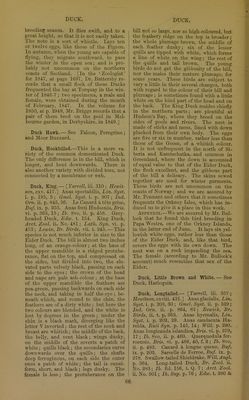
![has not in itself any additional heat (as is vulgarly im^ned) beyond other sub- stances, for it would equally preserve ice from thawing as it would heated water, or eggs from cooling, upon the sole principle of its being a bad conductor of caloric, and consequently would cut off a ready com- munication between the ice and the warmer air. Coverings for beds, quilted or stuffed with Eider down, keep the body warm by interposing an obstacle to the expenditure of animal heat, by shutting the avenues to the colder air, wliich in a frigid climate so rapidly carries off the caloric. For a similar pui^pose are blankets used in our more moderate climate, and the finer the wool of which they are ma- nufactured, and the more shaggy they are, the better will they answer the purpose for which they are intended. It is a mis- taken notion that only Eider down is used for the piu’poses above mentioned. It is true all the do^vn which is taken by the natives of the more northern regions is sold for such, but many others of the Duck tribe afford down not inferior to that of the Eider, but none in such great abun- dance : these however are mixed together and carried to mai’ket without discrimina- tion. Duck, Ferruginous. — \_Yarrell, iii. 339; Hewitson, cx\-ii. 425.] Anas rufa. Faun. Suec. No. 134. Anas ferruginea, Gmel. Syst. ii. p. 528; Ind. Orn. ii. p. 866, 84. Eed Duck, Arct. Zool. ii. No. 576, N. Fer- ruginous Duck, Br. Zool. ii. No. 285, t. 99; Lath. Syn. vi. p. 526, 17. Eed-breasted Duck, Lewin, Br. Birds, vii. t. 224. Anas nyroca, Gmel. Syst. ii. p. 542; Ind. Orn. ii. p. 869. Tufted Duck, Var. A., Lath. Syn. vi. p. 541, No. 79. Olive-tufted Duck, Br. Miscel. 1, t. 21. — This species weighs twenty ounces. The bill is long and flatted, a little rounded at the base; co- lour pale blue. Head, neck, and whole upper parts of the body reddish brown; throat, breast, and belly the same, but paler; legs pole blue; webs black. Mr. Pennant informs us this bird was killed in Lincolnshire. It is the only specimen on record in England; but is said to be found in Denmark and Sweden. No men- tion is made respecting the difierence of sexes, or whether that above described was male or female. [In the ‘ Zoologist ’ for 1848, p. 2230, Mr. F. W. Johnson re- cords the purchase of a fine specimen of the Ferruginous Duck in Leadenhall mar- ket : in the same work, for 1849, theEevs. A. and H. Matthews record, at p. 2539, the occurrence of three specimens in Ox- fordshire : in the volume for 1850 Mr. Eiidd, of Eedcor, records, at p. 2773, the capture of one specimen iu a decoy in that neighbourhood: and lastly, at p. 2803, Mr. Eising states, that a fine male was shot on the 16th of April, 1850, on a marsh near Great Yarmouth.] Supplement. — Till lately we never had met with any species of Duck which could be referred to the fenuginous originally described by Mr. Pennant, and which was without doubt a female. A specimen which we suspect is the male, shot in the north of England (we believe in the Hum- ber), is now before us; a description of which cannot fail to be interesting to the Ornitholo^st. Length about nineteen inches: bill rather long, and deep at the base, flatti.sh at the point, and of a dark lead-coloui', with the nail black. Head and neck small, of a dark ferruginous : the lower pai-t of the neck behind, back, sca.- pulars, coverts of the wings, and upper coverts of the tail dusky brown, with a slight tinge of fenuginous : on the chin is a small spot of dirty white: the lower part of the neck before, and the whole breast chesnut; beneath which the body is white to the thighs, which, vuth the part be- tween them as far as the vent, are brown, minutely speckled, becoming black about the vent; behind that, including the un- der tail-coverts, white: the feathers on the sides under the wings, extending to the thighs, are bright ferruginous: the primary quills are whitish at their base, dusky at the tips and on the outer webs, becoming less so as they approach the secondaries, which are wholly white ex- cept the points, and form a white specu- lum on the wing when closed: the tertials, and the coverts immediately impending the secondaries, are dusky, bronzed with green: the other darker parts of the pliun- age joai'take more or less of metallic lustre in some points of view, especially the sca- pulars : the under scapulars are white: the tail is a trifle cuneiform, consisting of fourteen dusky brown feathers slightly tinged with ferruginous : feet rather large, which ■with the webs and legs are leM- colour: the middle toe rather longer than the outer one: claws black. The eyes appeared to have been yellow; bnt the sex could not be ascertained; the brightness of the plumage, however, should indicate the gender to be mascuUne. We really suspect this to be the male of the Ferru- ginous Duck of the ‘ British Zoology,’ and copied from that work by all succeeding writers. It is most certainly the Olive- tufted Duck of the ‘ British Miscellany;’ and we think there can be no doubt that it is the nyroca of Gmelin. It must be confessed many of the Duck tribe are still in gi’eat obscurity, as it is well known that some species differ so essentially in their plumage at different ages and seasons, that](https://iiif.wellcomecollection.org/image/b28089935_0092.jp2/full/800%2C/0/default.jpg)




 No text description is available for this image
 No text description is available for this image
 No text description is available for this image