On the arachnida collected by the 'Skeat expedition' to the Malay peninsula, 1899-1900 / by Eugène Simon.
- Eugène Simon
- Date:
- 1901
Licence: In copyright
Credit: On the arachnida collected by the 'Skeat expedition' to the Malay peninsula, 1899-1900 / by Eugène Simon. Source: Wellcome Collection.
Provider: This material has been provided by The Royal College of Surgeons of England. The original may be consulted at The Royal College of Surgeons of England.
3/42 page 45
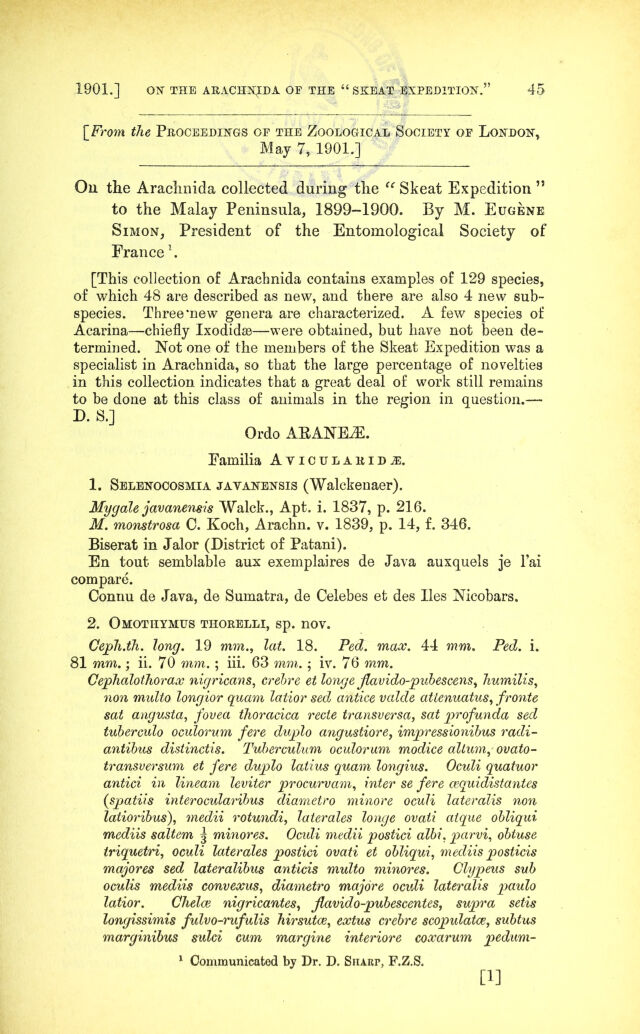
![\_From the Proceedihgs oe the Zoological Sooiety of Loxdon, May 7, 1901.] Oh tlie Araclmida collected during the “ Skeat Expedition ” to the Malay Peninsula, 1899-1900. By M. Eugene Simon, President of the Entomological Society of France \ [This eollection of Arachnida contains examples of 129 species, of which 48 are described as new, and there are also 4 new sub- species. Three*new genera are cbaracterized. A few species of Acarina—cbiefly Ixodidse—were obtained, but have not been de- termined. Not one of the members of the Skeat Expedition was a specialist in Arachnida, so that the large percentage of novelties in this eollection indicates that a great deal of work stili remains to be done at this class of animals in the region in question.— D. S.] Ordo ABANEAL Familia AticulabiDtE. 1. Selehocosmia javahehsis (Walckenaer). Mygale javanensis Walck., Apt. i. 1837, p. 216. M. monstrosa C. Koch, Arachn. v. 1839, p. 14, f. 346. Biserat in Jalor (District of Patani). En tout semblable aux exemplaires de Java auxquels je l’ai compare. Connu de Java, de Sumatra, de Celebes et des lies Nicobars. 2. Omothymus thorelli, sp. nov. Ceph.th. long. 19 mm., lat. 18. Ped. max. 44 mm. Ped. i. 81 mm.; ii. 70 mm.; iii. 63 mm.; iv. 76 mm. CephalotJiorax nigricans, crebre et longe jlavido-pubescens, humilis, non multo longior quam latior sed antice valde attenuatus, fronte sat angusta, fovea thoracica recte transversa, sat profunda sed tuberculo oculorum fere duplo angustiore, impressionibus radi- antibus distinctis. Tuberculum oculorum modice altum,- ovato- transversum et fere duplo latius quam longius. Oculi quatuor antici in lineam leviter procurvam, inter se fere cequidistantes (spatiis interocularibus diametro minore oculi lateralis non latioribus), medii rotundi, laterales longe ovati atque obliqui mediis saltem ^ minores. Oculi medii postici albi, parvi, obtuse triquetri, oculi laterales postici ovati et obliqui, mediis posticis majores sed lateralibus anticis multo minores. Clypeus sub oculis mediis convexus, diametro majore ocidi lateralis paulo latior. Clielce nigricantes, jlavido-pubescentes, supra setis longissimis fulvo-rufulis hirsutae, extus crebre scopulatce, subtus marginibus sulci cum margine interiore coxarum pedum- 1 Communicated by Dr. D. Sharp, F.Z.S, [E](https://iiif.wellcomecollection.org/image/b22406530_0005.jp2/full/800%2C/0/default.jpg)