Morris's human anatomy : a complete systematic treatise by English and American authors / ed. by C.M. Jackson eleven hundred and eighty two illustrations, three hundred and fifty eight printed in colors.
- Sir Henry Morris, 1st Baronet
- Date:
- [1914], [©1914]
Licence: Public Domain Mark
Credit: Morris's human anatomy : a complete systematic treatise by English and American authors / ed. by C.M. Jackson eleven hundred and eighty two illustrations, three hundred and fifty eight printed in colors. Source: Wellcome Collection.
Provider: This material has been provided by the Augustus C. Long Health Sciences Library at Columbia University and Columbia University Libraries/Information Services, through the Medical Heritage Library. The original may be consulted at the the Augustus C. Long Health Sciences Library at Columbia University and Columbia University.
49/1564 (page 29)
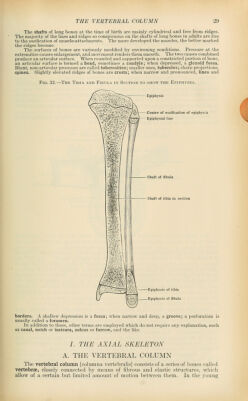
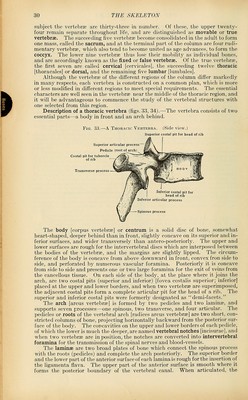
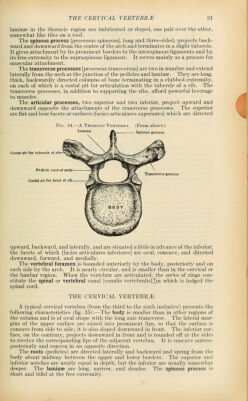
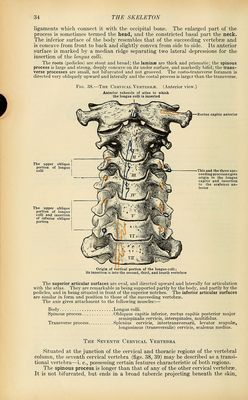
![The shafts ot long bones at the time of birth are mainly cylindrical and free from ridges. The majority of the lines and ridges so conspicuous on the shafts of long bones in adults are due to the ossification of muscle-attachments. The more developed the muscles, the better marked the ridges become. The surfaces of bones are variously modified by environing conditions. Pressure at the •extremities causes enlargement, and movement renders them smooth. The two causes combined produce an articular surface. When rounded and supported upon a constricted portion of bone, -an articular surface is termed a head, sometimes a condyle; when depressed, a glenoid fossa. Blunt, non-articular processes are called tuberosities; smaller ones, tubercles; sharp projections, spines. Slightly elevated ridges of bones are crests; when narrow and pronounced, lines and Fig. 32.—The Tibia and Fibula in Section to show the Epiphyses. Centre of ossification of epiphysis Epiphysial line i Shaft of fibula Shaft of tibia in section Epiphysis of tibia {J_ Epiphysis of fibula borders. A shallow depression is a fossa; when narrow and deep, a groove; a perforation is usually called a foramen. In addition to these, other terms are employed which do not require any e.xplanation, such as canal, notch or incisura, sulcus or furrow, and the like. /. THE AXIAL SKELETON A. THE VERTEBRAL COLUMN The vertebral column [columna vertebralis] consists of a series of bones called vertebrae, closely connected by means of fibrous and elastic structures, which allow of a certain but limited amount' of motion between them. In the young](https://iiif.wellcomecollection.org/image/b21212600_0049.jp2/full/800%2C/0/default.jpg)