Morris's human anatomy : a complete systematic treatise by English and American authors / ed. by C.M. Jackson eleven hundred and eighty two illustrations, three hundred and fifty eight printed in colors.
- Sir Henry Morris, 1st Baronet
- Date:
- [1914], [©1914]
Licence: Public Domain Mark
Credit: Morris's human anatomy : a complete systematic treatise by English and American authors / ed. by C.M. Jackson eleven hundred and eighty two illustrations, three hundred and fifty eight printed in colors. Source: Wellcome Collection.
Provider: This material has been provided by the Augustus C. Long Health Sciences Library at Columbia University and Columbia University Libraries/Information Services, through the Medical Heritage Library. The original may be consulted at the the Augustus C. Long Health Sciences Library at Columbia University and Columbia University.
51/1564 (page 31)
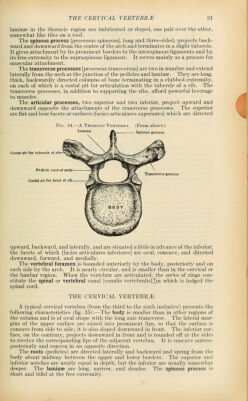
![laminse in the thoracic region are imbricated or sloped, one pair over the other, somewhat like tiles on a roof. The spinous process [processus spinosus], long and three-sided, projects back- ward and downward from the centre of the arch and terminates in a slight tubercle. It gives attachment by its prominent borders to the interspinous ligaments and by its free extremity to the supraspinous ligament. It serves mainly as a process for muscular attachment. The transverse processes [processus transversus] are two in number and extend laterally from the arch at the junction of the pedicles and laminse. They are long, thick, backwardly directed columns of bone terminating in a clubbed extremity, on each of which is a costal pit for articulation with the tubercle of a rib. The transverse processes, in addition to supporting the ribs, afford powerful leverage to muscles. The articular processes, two superior and two inferior, project upward and downward opposite the attachments of the transverse processes. The superior are flat and bear facets or surfaces [facies articulares superiores] which are directed Fig. 34.—A Thoracic Vertebra. Lamina Costal pit for tubercle of rib i Pedicle (root of arch) Costal pit for head of rib Transverse process upward, backward, and laterally, and are situated a little in advance of the inferior, the facets of which [facies articulares inferiores] are oval, concave, and directed downward, forward, and medially. The vertebral foramen is bounded anteriorly by the body, posteriorly and on each side by the arch. It is nearly circular, and is smaller than in the cervical or the lumbar region. When the vertebrae are articulated, the series of rings con- stitute the spinal or vertebral canal [canalis vertebralis],^in which is lodged the spinal cord. THE CERVICAL VERTEBRA A typical cervical vertebra (from the third to the sixth inclusive) presents the following characteristics (fig. 35):—The body is smaller than in other regions of the column and is of oval shape with the long axis transverse. The lateral mar- gins of the upper surface are raised into prominent lips, so that the surface is concave from side to side; it is also sloped downward in front. The inferior sur- face, on the contrary, projects downward in front and is rounded off at the sides to receive the corresponding lips of the adjacent vertebra. It is concave antero- posteriorly and convex in an opposite direction. The roots (pedicles) are directed laterally and backward and spring from the body about midway between the upper and lower borders. The superior and inferior notches are nearly equal in depth, but the inferior are usually somewhat deeper. The laminse are long, narrow, and slender. The spinous process is short and bifid at the free extremity.](https://iiif.wellcomecollection.org/image/b21212600_0051.jp2/full/800%2C/0/default.jpg)