Morris's human anatomy : a complete systematic treatise by English and American authors / ed. by C.M. Jackson eleven hundred and eighty two illustrations, three hundred and fifty eight printed in colors.
- Sir Henry Morris, 1st Baronet
- Date:
- [1914], [©1914]
Licence: Public Domain Mark
Credit: Morris's human anatomy : a complete systematic treatise by English and American authors / ed. by C.M. Jackson eleven hundred and eighty two illustrations, three hundred and fifty eight printed in colors. Source: Wellcome Collection.
Provider: This material has been provided by the Augustus C. Long Health Sciences Library at Columbia University and Columbia University Libraries/Information Services, through the Medical Heritage Library. The original may be consulted at the the Augustus C. Long Health Sciences Library at Columbia University and Columbia University.
60/1564 (page 40)
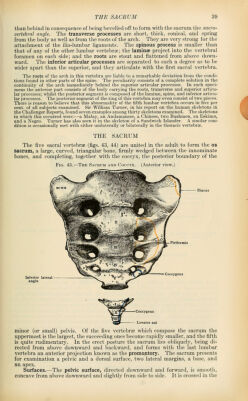
![middle by four transverse ridges [lineae transversee] which represent the ossified intervertebral discs and separate the bodies of the five sacral vertebrae. Of the bodies, the first and second are nearly equal in size and are larger than the third, fourth, and fifth, which, in vertical depth, are also nearly equal to each other. At the extremities of the transverse ridges on each side are four openings, called the anterior sacral foramina, which correspond to the intervertebral foramina in other regions of the column, and transmit the anterior divisions of the first four sacral nerves; they are also traversed by branches of the lateral sacral arteries. The fora- mina are separated by wide processes, representing the costal processes of the vertebrae, which unite laterally to form the lateral portion (or mass) [pars lateralis]. The latter is grooved for the sacral nerves, and rough opposite the second, third, and fourth sacral vertebrae, for the origin of the piriformis muscle. The lateral part of the fifth sacral vertebra gives insertion to fibres of the coccygeus. . The dorsal surface is strongly convex and rough. The middle line is occu- pied by four eminences representing the somewhat suppressed spinous processes. Of these the first is the largest, the second and third may be confluent, and the fourth is often absent. The processes are united to form an irregular ridge or The Sacrum. (Posterior view.) Articular process Auricular surface Articular process' Transverse process Sacral foramen- Multifidus Sacro-spinalis Gluteus maximus Notch for fifth sacral crest [crista sacralis media]. The bone on each side of the spines is slightly hollowed and is formed by the united laminae. In the fourth sometimes, but always in the fifth, the laminae fail to meet in the middle line, leaving a gap [hiatus sacralis] at the termination of the spinal canal, the lateral margins of which are prolonged downward as the sacral cornua. They represent the lower articular processes of the fifth sacral vertebra and give attachment to the posterior sacro- coccygeal ligaments. Lateral to the laminae is a second series of small eminences which represent the articular and mammillary processes of the vertebrae above. The first pair are large for the last lumbar vertebra, the second and third are small, and the fourth and fifth are inconspicuous. Together they form a pair of irregular ridges [cristae sacrales articulares]. Immediately lateral to the articular processes are the posterior sacral fora- mina, four on each side; they are smaller than the anterior, and give exit to the posterior primary divisions of the first four sacral nerves. Lateral to the fora^ mina on each side are five elevations representing the transverse processes. The first pair, situated at the junction of the posterior surface with the base, are large and conspicuous, and serve all for the attachment of ligaments and muscles.](https://iiif.wellcomecollection.org/image/b21212600_0060.jp2/full/800%2C/0/default.jpg)