Morris's human anatomy : a complete systematic treatise by English and American authors / ed. by C.M. Jackson eleven hundred and eighty two illustrations, three hundred and fifty eight printed in colors.
- Sir Henry Morris, 1st Baronet
- Date:
- [1914], [©1914]
Licence: Public Domain Mark
Credit: Morris's human anatomy : a complete systematic treatise by English and American authors / ed. by C.M. Jackson eleven hundred and eighty two illustrations, three hundred and fifty eight printed in colors. Source: Wellcome Collection.
Provider: This material has been provided by the Augustus C. Long Health Sciences Library at Columbia University and Columbia University Libraries/Information Services, through the Medical Heritage Library. The original may be consulted at the the Augustus C. Long Health Sciences Library at Columbia University and Columbia University.
62/1564 (page 42)
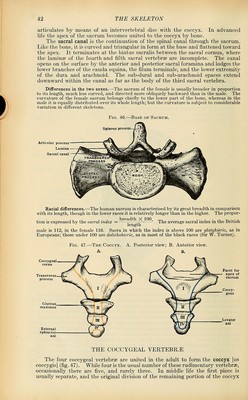
![articulates by means of an intervertebral disc with the coccyx. In advanced life the apex of the sacrum becomes united to the coccyx by bone. The sacral canal is the continuation of the spinal canal through the sacrum. Like the bone, it is curved and triangular in form at the base and flattened toward the apex. It terminates at the hiatus sacralis between the sacral cornua, where the laminse of the fourth and fifth sacral vertebrae are incomplete. The canal opens on the surface by the anterior and posterior sacral foramina and lodges the lower branches of the cauda equina, the filum terminale, and the lower extremity of the dura and arachnoid. The sub-dural and sub-arachnoid spaces extend downward within the canal as far as the body of the third sacral vertebra. Differences in the two sexes.—The sacrum of the female is usually broader in proportion to its length, much less curved, and directed more obliquely backward than in the male. The curvature of the female sacrum belongs chiefly to the lower part of the bone, whereas in the male it is equally distributed over its whole length; but the curvature is subject to considerable variation in different skeletons. Fig. 46.—Base of Sacrum. Spinous process—j^fjf^ij cular process Lamina Sacral canal Racial differences.—The human sacrum is characterised by its great breadth in comparison with its length, though in the lower races it is relatively longer than in the higher. The propor- tion is expressed by the sacral index = .——rr ' The average sacral index in the British male is 112, in the female 116. Sacra in which the index is above 100 are plaiyhieric, as in Europeans; those under 100 are dolichohieric, as in most of the black races (Sir W. Turner). Fig. 47.—The Coccyx. A. Posterior view; B. Anterior view. A. B. THE COCCYGEAL VERTEBRiE The four coccygeal vertebrae are united in the adult to form the coccyx [os coccygis] (fig. 47). While four is the usual number of these rudimentary vertebrse, occasionally there are five, and rarely three. In middle life the first piece is usually separate, and the original division of the remaining portion of the coccyx](https://iiif.wellcomecollection.org/image/b21212600_0062.jp2/full/800%2C/0/default.jpg)