Pilosine : a new alkaloid from Pilocarpus microphyllus / by Frank Lee Pyman.
- Pyman, Frank Lee.
- Date:
- [between 1910 and 1919?]
Licence: In copyright
Credit: Pilosine : a new alkaloid from Pilocarpus microphyllus / by Frank Lee Pyman. Source: Wellcome Collection.
12/12 (page 2271)
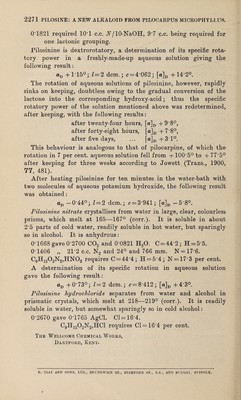
![0'1821 required lO'l c.c. A/lO-NaOH, 9*7 c.c. being required for one lactonic grouping. Pilosinine is dextrorotatory, a determination of its specific rota¬ tory power in a freshly-made-up aqueous solution giving the following result: aD + 1*15°; 1 = 2 dcm.; c = 4*062; [a]D +14*2°. The rotation of aqueous solutions of pilosinjne, however, rapidly sinks on keeping, doubtless owing to the gradual conversion of the lactone into the corresponding hydroxy-acid; thus the specific rotatory power of the solution mentioned above was redetermined, after keeping, with the following results: after twenty-four hours, [ct]D + 9*8°, after forty-eight hours, [a]D +7*8°, after five days, ... [a]D +3T°. This behaviour is analogous to that of pilocarpine, of which the rotation in 7 per cent, aqueous solution fell from + 100*5° to + 77*5° after keeping for three weeks according to Jowett (Trans., 1900, 77, 481). After heating pilosinine for ten minutes, in the water-bath with two molecules of aqueous potassium hydroxide, the following result was obtained: aD —0*44°; Z = 2 dcm.; c = 3*941; ra]D —5*8°. Pilosinine nitrate crystallises from water in large, clear, colourless prisms, which melt at 165—167° (corr.). It is soluble in about 2*5 parts of cold water, readily soluble in hot water, but sparingly so in alcohol. It is anhydrous: 0*1668 gave0*2700 C02 and 0*0821 H20. C = 44*2; H = 5*5. 0*1406 „ 21*2 c.c. N2 and 24° and 766 mm. N = 17*6. C9H1202N2,HN03 requires C = 44*4; 11 = 5*4; N = 17*3 per cent. A determination of its specific rotation in aqueous solution gave the following result: aD +0*73°; 1 = 2 dcm.; c = 8*412; [a]D -j-4*3°. Pilosinine hydrochloride separates from water and alcohol in prismatic crystals, which melt at 218—219° (corr.). It is readily soluble in water, but somewhat sparingly so in cold alcohol: 0*2670 gave 0*1765 AgCl. Cl = 16*4. C9H1202N2,HC1 requires Cl = 16*4 per cent. The Wellcome Chemical Works, Hartford, Kent. R. CLAY AND SONS, LTD., BRUNSWICK ST., STAMFORD ST., S.E., AND BUNGAY, SUFFOLK.](https://iiif.wellcomecollection.org/image/b30622256_0012.jp2/full/800%2C/0/default.jpg)