Pilosine : a new alkaloid from Pilocarpus microphyllus / by Frank Lee Pyman.
- Pyman, Frank Lee.
- Date:
- [between 1910 and 1919?]
Licence: In copyright
Credit: Pilosine : a new alkaloid from Pilocarpus microphyllus / by Frank Lee Pyman. Source: Wellcome Collection.
2/12 page 2261
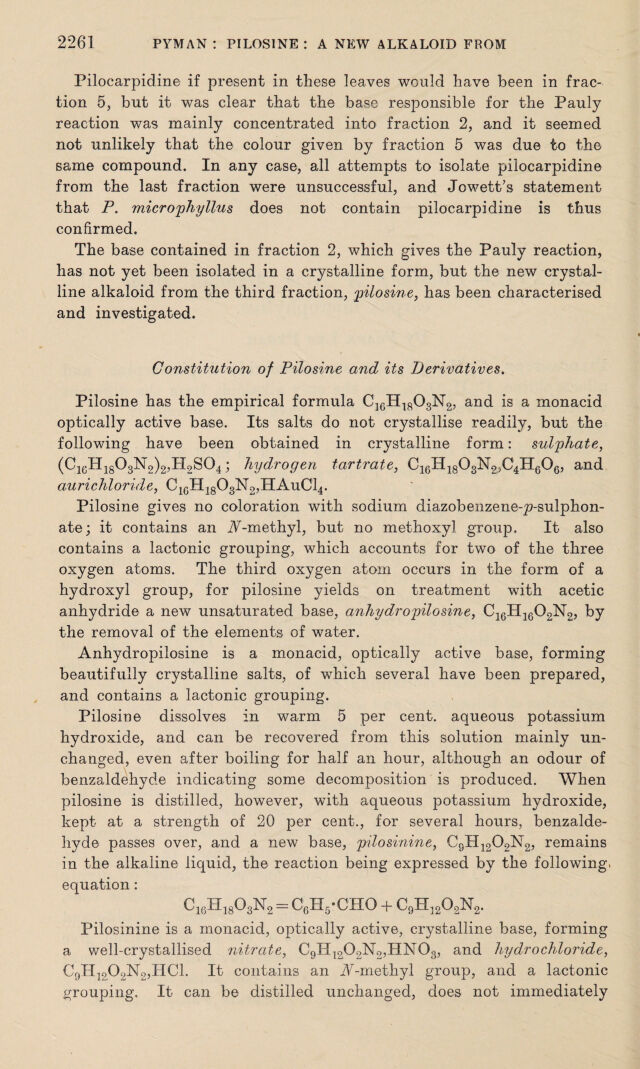
![Pilocarpidine if present in these leaves would have been in frac¬ tion 5, but it was clear that the base responsible for the Pauly reaction was mainly concentrated into fraction 2, and it seemed not unlikely that the colour given by fraction 5 was due to the same compound. In any case, all attempts to isolate pilocarpidine from the last fraction were unsuccessful, and Jewett’s statement that P. microphyllus does not contain pilocarpidine is thus confirmed. The base contained in fraction 2, which gives the Pauly reaction, has not yet been isolated in a crystalline form, but the new crystal¬ line alkaloid from the third fraction, pilosine, has been characterised and investigated. Constitution of Pilosine and its Derivatives. Pilosine has the empirical formula C16H1803N2, and is a monacid optically active base. Its salts do not crystallise readily, but the following have been obtained in crystalline form: sulphate, (C16His03N 2)2,PI2S04; hydrogen tartrate, C16H1803N2,C4H606, and aurichloride, C16H1803N2,HAuC14. Pilosine gives no coloration with sodium diazobenzene-p-sulphon- ate; it contains an A-methyl, but no methoxyl. group. It also contains a lactonic grouping, which accounts for two of the three oxygen atoms. The third oxygen atom occurs in the form of a hydroxyl group, for pilosine yields on treatment with acetic anhydride a new unsaturated base, anhydropilosine, C16H1602N2, by the removal of the elements of water. Anhydropilosine is a monacid, optically active base, forming beautifully crystalline salts, of which several have been prepared, and contains a lactonic grouping. Pilosiue dissolves in warm 5 per cent, aqueous potassium hydroxide, and can be recovered from this solution mainly un¬ changed, even after boiling for half an hour, although an odour of benzaldehyde indicating some decomposition is produced. When pilosine is distilled, however, with aqueous potassium hydroxide, kept at a strength of 20 per cent., for several hours, benzalde¬ hyde passes over, and a new base, pilosinine, C9H1202N2, remains in the alkaline liquid, the reaction being expressed by the following, equation: C1cH1803N2 = CgHj-CHO + C9H]202N2. Pilosinine is a monacid, optically active, crystalline base, forming a well-crystallised nitrate, C9H1209N2,HN03, and hydrochloride, C9H1202N2,HC1. It contains an N-methyl group, and a lactonic grouping. It can be distilled unchanged, does not immediately](https://iiif.wellcomecollection.org/image/b30622256_0002.jp2/full/800%2C/0/default.jpg)