Pilosine : a new alkaloid from Pilocarpus microphyllus / by Frank Lee Pyman.
- Pyman, Frank Lee.
- Date:
- [between 1910 and 1919?]
Licence: In copyright
Credit: Pilosine : a new alkaloid from Pilocarpus microphyllus / by Frank Lee Pyman. Source: Wellcome Collection.
9/12 page 2268
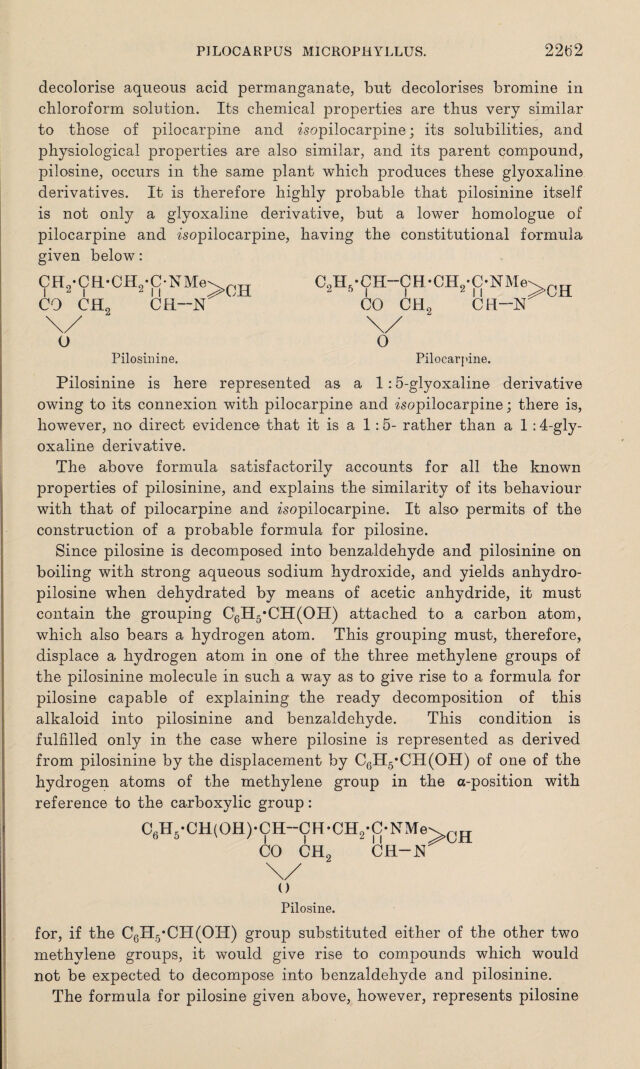
![C6H5-CH:C-CH-CH2*C-NMe\CH Anhydropilosine, CO CIi2 CR-N \/ O Pilosine loses the elements of water when boiled for a short time with acetic anhydride; if undiluted acetic anhydride is used, a certain amount of charring takes place, and the quality and quantity of the resulting product, anhydropilosine, is unsatisfactory. On the other hand, boiling with glacial acetic acid does not dehydrate pilosine. By boiling pilosine, however, for a short time with a mixture of equal volumes of acetic anhydride and glacial acetic acid, anhydropilosine is readily obtained in nearly theoretical yield. Ten grams of pilosine, 20 c.c. of glacial acetic acid, and 20 c.c. of acetic anhydride were boiled for half-an-hour under a reflux condenser. The product was diluted with water, and mixed with a slight excess of ammonia, when most of the anhydropilosine was precipitated, and became crystalline on seeding and stirring; the remainder was obtained by extracting the liquor with chloroform. Anhydropilosine crystallises from ethyl acetate in clusters of colour¬ less rods, which melt at 133—134° (corr.). It suffers no loss at 100°: 0T682 gave 0'4400 C02 and 0‘0896 H20. 0 = 71*4; H = 6‘0. C16H1602N2 requires C = 71*6; H = 6*0 per cent. Anhydropilosine is sparingly soluble in cold, readily so in hot, water; it is very readily soluble in alcohol, acetone, benzene, chloro¬ form, or warm ethyl acetate; fairly readily so in cold ethyl acetate, and sparingly soluble in ether. Unlike pilosine, it immediately decolorises aqueous permanganate. The presence of a lactonic grouping in this compound was shown, as in the case of pilosine: 0T805 required 6*4 c.c. A/10-NaOH, 6*7 c.c. being required for one lactonic grouping. Anhydropilosine is dextrorotatory, a determination of its specific rotation in 95 per cent, alcohol giving the following result: ccD + 4*73°; 1 = 2 dcm.; c = 3*571; [a]D + 66*2°. After heating anhydropilosine for ten minutes in the water-bath with two molecules of potassium hydroxide in aqueous solution, the following result was obtained: aD — 8*34°; 1 = 2 dcm.; c = 3'142; [a]D —132*7°. Anhydropilosine forms salts which crystallise readily. Anhydropilosine sulphate separates from absolute alcohol in clusters of prisms, which melt at 174° (corr.) after sintering a few](https://iiif.wellcomecollection.org/image/b30622256_0009.jp2/full/800%2C/0/default.jpg)

 No text description is available for this image
 No text description is available for this image
 No text description is available for this image