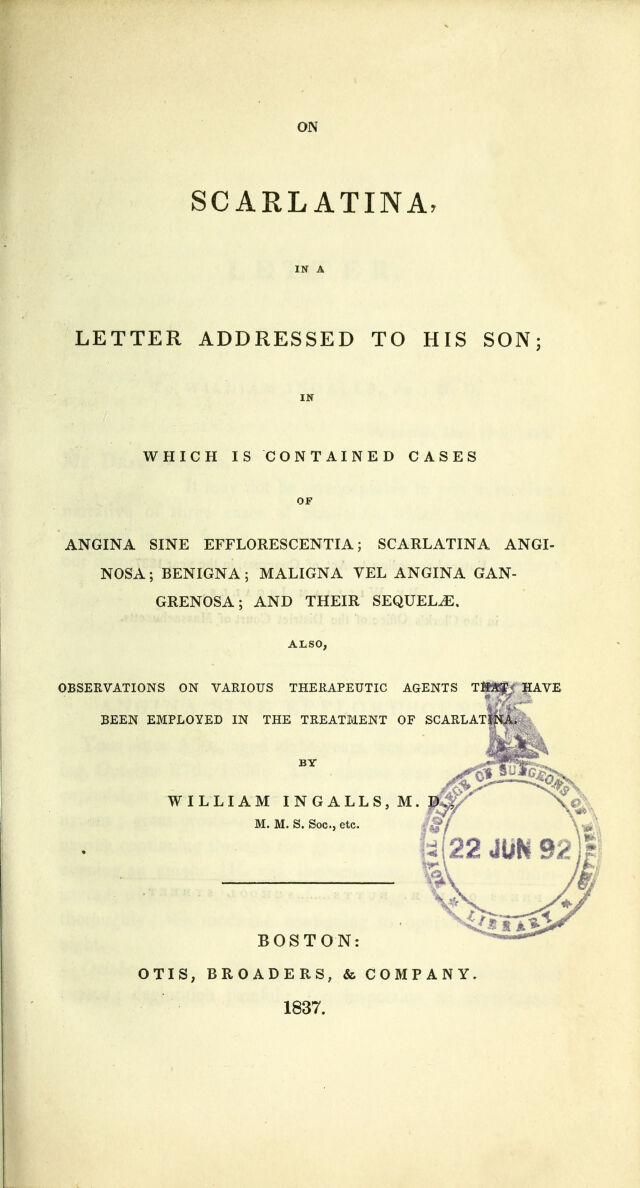
On scarlatina : in a letter addressed to his son, in which is contained cases of angina sine efflorescentia, scarlatina anginosa, benigna, maligna vel angina gangrenosa, and their sequelae : also, observations on various therapeutic agents that have been employed in the treatment of scarlatina / by William Ingalls.
- William Ingalls
- Date:
- 1837
Licence: Public Domain Mark
Credit: On scarlatina : in a letter addressed to his son, in which is contained cases of angina sine efflorescentia, scarlatina anginosa, benigna, maligna vel angina gangrenosa, and their sequelae : also, observations on various therapeutic agents that have been employed in the treatment of scarlatina / by William Ingalls. Source: Wellcome Collection.
Provider: This material has been provided by The Royal College of Surgeons of England. The original may be consulted at The Royal College of Surgeons of England.
38/42 page 36
![ance of being about to suppurate; and the mucous membrane in its vicinity was inflamed and thickened. Varicella. The last of February, 1837, John broke out with the chicken-pox. The premonitory symptoms were lassi- tude and cephalalgia, which soon after were followed by an eruption in various parts of the body: behind the ear, there was discovered a pock, which filled and burst on the fourth day ; the fluid it contained was limpid till the fourth, when it became somewhat opake ; on the fifth the contents of the pustule or vesicle had disappeared. On the face there were several small vesicles, which, not- withstanding their diminutive size, left pits ; on the breast they were large, shallow, and of short duration; on the posterior region of the thorax, among others, there were three of large size upon which wer« formed scabs, two of which remained about four weeks, when they fell off, leaving pits which pene- trated through the superficial tissues deep into the cutis vera. The pox [ properly pocks] (I should prefer the word pock and to make use of it as a noun of multitude) with the excep- tion of the desquamation of the scabs on the posterior region of the thorax, passed through the several stages about the same time with the vesicle behind the ear. Anorexia; cepha- lalgia ; propensity to lie a-bed ; incited action of the vascular system; continued three days. So far as we know, John's disease was sporadic. This case has been given in detail, as th^re are in Europe eminent practitioners, who contend the varicella and variola are identic ; and as the history of the latter in Boston furnishes irrefragable proof, however striking the resemblance, the chicken is never converted into the small pox. To prevent the spreading of the variolous contagion, two measures were adopted; first, inoculation was prohibited; second, for the accommodation of families liable to suffer from](https://iiif.wellcomecollection.org/image/b22274376_0040.jp2/full/800%2C/0/default.jpg)