Cataract extraction : being a series of papers with discussion and comments read before the Ophthalmological section of the New York academy of medicine, 1907-1908 / edited by J. Herbert Claiborne.
- Date:
- 1908
Licence: Public Domain Mark
Credit: Cataract extraction : being a series of papers with discussion and comments read before the Ophthalmological section of the New York academy of medicine, 1907-1908 / edited by J. Herbert Claiborne. Source: Wellcome Collection.
Provider: This material has been provided by the Francis A. Countway Library of Medicine, through the Medical Heritage Library. The original may be consulted at the Francis A. Countway Library of Medicine, Harvard Medical School.
185/192 page 169
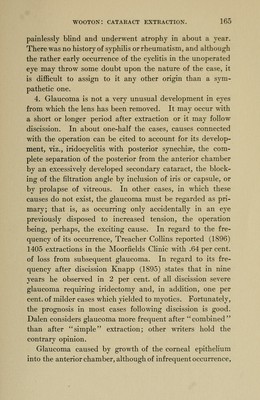
![vitreous does predispose to subsequent detachment but it must be remembered that in a certain, perhaps the greater number of these cases, the vitreous was probably fluid before extraction was performed and that detachment might have taken place ultimately even had no operative procedure been attempted. [The operation for cataract without a doubt requires more skill, more nerve, more judgment and greater readiness to cope with unexpected disaster and accident than any other surgical procedure possible on the human body. But even when the lens has been removed by simple ex- traction and a round nimble pupil is obtained, the result is at best a failure by virtue of the lack of accommodation and the necessity of wearing thick and unsightly lenses. Since there are many very old people who never have opacities of the lens, it would be incorrect to say that cata- ract is a necessary concomitant of old age. And when we reflect that the majority of cataracts occur in those in the lower walks of life, whose lives have not been regulated on hygienic principles, particularly with reference to the care of the eyes, it is safe to predict that the treatment of cataract in the future will be prophylactic, and consequently it is not unreasonable to predict that it will cease to occur and that all men may at some time in the future go down to their graves preserving to the last the noblest of their faculties. This result will probably be gained not by the brilliant achievement of one man, but by that slow and painstaking process by which all lasting results in science are attained. J. h. c] finis.](https://iiif.wellcomecollection.org/image/b21175639_0185.jp2/full/800%2C/0/default.jpg)



 No text description is available for this image
 No text description is available for this image
 No text description is available for this image