Text-book of palaeontology / by Karl A. von Zittel ; translated and edited by Charles R. Eastman.
- Karl Alfred von Zittel
- Date:
- 1900
Licence: In copyright
Credit: Text-book of palaeontology / by Karl A. von Zittel ; translated and edited by Charles R. Eastman. Source: Wellcome Collection.
694/728 page 678
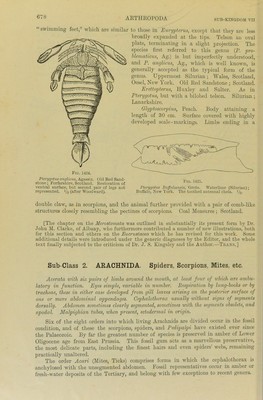
![SUB-KINGDOM VII “ swimming feet,” whicll are similar to those in Eurypterus, except that tliey are less broadly expanded at tlie tips. Telson an oval plate, terminating in a slight projection. The speeies first referred to this genus (P. pro- blematicus, Ag.) is but imperfectly understood, and P. anglicus, Ag., wliicli is well known, is generally accepted as tlie typical form of the genus. Uppermost Silurian; Wales, Scotland, Oesel, New York. Old Red Sandstone ; Scotland. Erettoplerus, Huxley and Salter. As in Pterygotus, but witli a bilobed telson. Silurian ; Lanarksliire. Glyp/toscorpius, Peach. Body attaining a lengtli of 30 cm. Surface covered with bighly developed scale-markings. Limbs ending in a Fic. 1424. Pterygotus anglicus, Agassiz. Old Red Sand- stone ; Forfarsliire, Scotland. Restovation of ventral surface, but second pair of legs not represented. 1/5 (after Woodward). Fio. 1425. Pterygotus Buffaloensis, 'Grote. Waterlirae (Silurian); Buffalo, New York. Tlie tootlied antennal cliela. i/2. double claw, as in scorpions, and the animal further provided with a pair of comb-like structures closely resembling the pectines of scorpions. Coal Measures; Scotland. [The chapter on the Merostomata was outlined in substantially its present form by Dr. John M. Clarke, of Albany, who furthermore contributed a number of new illustrations, both for this section and others on the Eucrustacea wliich he has revised for this work. Some additional details were introduced under the generic diagnoses by the Editor, and the whole text finally subjected to the criticism of Dr. J. S. Kingsley and the Author.—Trans.] Sub-Class 2. ARACHNIDA. Spiders, Scorpions, Mites, etc. Acerata witli six pairs of limbs around the mouth, at least four of wliich are avibu- latory in function. Eyes simple, variable in number. llespiration by lung-boolcs or by tracheae, these in either case developed from gill leaves arising on the posterior surface of one or more abdominal appendages. Cephalotliorax usually without signs of segments dorsally. Abdomen sometimes clearly segmented, sometimes with the segments obsolete, and apodal. Malpighian tubes, wlien present, ectodermal in origin. Six of the eiglit Orders into wliich living Arachnids are divided occur in the fossil condition, and of these the scorpions, spiders, and Pedipalpi liave existed ever since the Palaeozoic. By far the greatest number of speeies is preserved in amber of Lower Oligocene age front East Prussia. This fossil gum acts as a marvellous preservative, the rnost delicate parts, including the finest liairs and even spiders’ webs, remaining practically unaltered. The order Acari (Mites, Ticks) comprises forms in wliich the cephalothorax is anchylosed with the unsegmented abdomen. Fossil repräsentatives occur in amber or fresh-water deposits of the Tertiary, and belong with few exceptions to recent genera.](https://iiif.wellcomecollection.org/image/b28132920_0694.jp2/full/800%2C/0/default.jpg)