Text-book of palaeontology / by Karl A. von Zittel ; translated and edited by Charles R. Eastman.
- Karl Alfred von Zittel
- Date:
- 1900
Licence: In copyright
Credit: Text-book of palaeontology / by Karl A. von Zittel ; translated and edited by Charles R. Eastman. Source: Wellcome Collection.
698/728 page 682
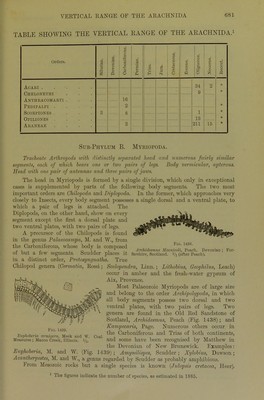
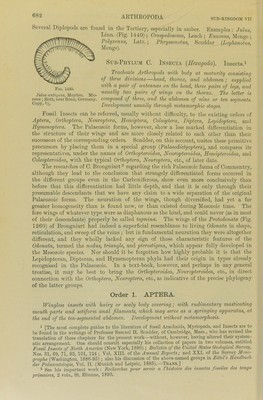
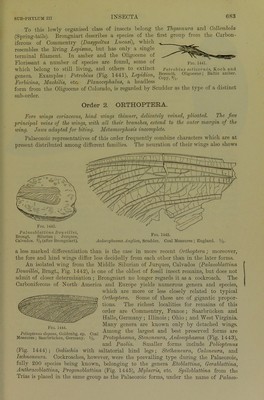
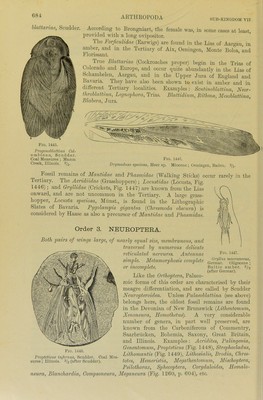
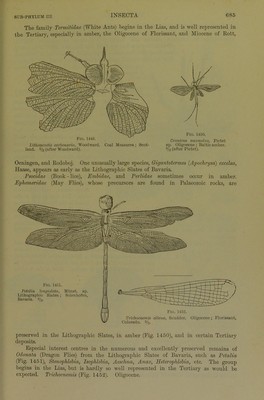
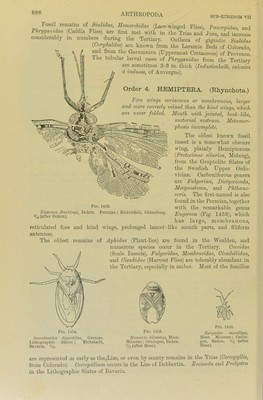
![SCB-KTNGDOM VII Several Diplopods are found in the Tertiary, especially in aniber. Examples: Julus, Linn. (Fig. 1440); Crasjoedosoma, Leacli; Euzonus, Menge; PoVyxenus, Latr. ; Phryssonotus, Scudder (Lophonotus, Menge). Süb-Phylum C. Insects.1 Fia. 1440. Jvlits antiquus, Heyden. Mio- cene ; Rott, nearBonn, Germany. Copy, Vi- INSEOTA (Ilexapoda). Trachcate Arthropods with body at maturity consisting of three divisions—head, thorax, and abdomen; supplied with a pair of antennae on the head, three pairs of legs, and usually two pairs of wings on the thorax. The latter is composed of three, and the abdomen of nine or ten segments. Development usually through metamorphic stages. Fossil Insects can be referred, usually witliout difficulty, to tlie existing Orders of Aptera, Orthoptera, Neuroptera, Hemiptera, Coleoptern, Diptera, Lepidoptera, and Hymenoptera. The Palaeozoic forms, however, show a less märked differentiation in the structure of their wings and are more closely related to each other than their successors of the corresponding ordere. Scudder, on this account, unites these primitive precursors by placing them in a special group (Palaeodictyoptera), and compares its representatives, under the names of Orthopteroidea, Neuropteroidea, Hemipteroidea, and Coleopteroidea, with the typical Orthoptera, Neuroptera, etc., of later date. The researches of C. Brongniart2 regarding the rieh Palaeozoic fauna of Commentry, although they lead to the conclusion that strangely differentiated forms occurred in the different groups even in the Carboniferous, show even more conclusively than before that this differentiation had little depth, and that it is only through their presumable descendants that we liave any claim to a wide Separation of the original Palaeozoic forms. The neuration of the wings, though diversified, had yet a far greater homogeneity than is found now, or than existed during Mesozoic time The fore wings of whatever type were as diaplianous as the hind, and could never (as in most of their descendants) properly be called tegmina. The wings of the Protodonata (Fig. 1260) of Brongniart had indeed a superficial resemblance to living Odonata in shape, reticulation, and sweep of the veins ; but in fundamental neuration they were altogether different, and they wliolly lacked any sign of tliose characteristic features of the Odonata, termed the nodus, triangle, and pterostigma, which appear fully developed in the Mesozoic species. Nor should it be forgotten how highly probable it is that the Lepidopteran, Dipteran, and Hymenopteran phyla had their origin in types already recognised in the Palaeozoic. In a text-book, liowever, and perhaps in any general treatise, it may be best to bring the Orthopteroidea, Neuropteroidea, etc., in direct connection with the Orthoptera, Neuroptera, etc., as indicative of tlie precise pliylogeny of the latter groups. Order 1. APTERA. Wingless insects with hairy or scaly body covering; with rudimentary niasticating mouth parts and setiform anal filaments, which may serve as a springing apparatus, at the end of the ten-segmented abdomen. Development without metamorpliosis. 1 [The most complete guides to the literature of fossil Arachnids, Myriopods, and Insects are to be found in tlie writings of Professor Samuel H. Scudder, of Cambridge, Mass., who has revised the translation of these chapters for the present work—without, however, having altered their system- atic arrangement. One should consult especially his collection of papers in two volumes, entitled Fossil Insects of North America (New York, 1890) ; Bulletin of the United States Oeological Surret/, Nos. 31, 69, 71, 93, 101, 124 ; Vol. XIII. of the Annual Reports; and XXI. of the Survey Mono- graphs (Washington, 1886-95) ; also his discussion of the above-named groups in ZitteVs Uandbuch der Palaeontologie, Vol. II. (Munich and Leipsic, 1885).—Tkans.] 2 See his important work : Recherches pour servir a l'hisloire des insectcs fossiles des temps primaires, 2 vols., St. Etienne, 1893.](https://iiif.wellcomecollection.org/image/b28132920_0698.jp2/full/800%2C/0/default.jpg)