A manual of operative surgery / By Lewis A. Stimson.
- Lewis Atterbury Stimson
- Date:
- 1885
Licence: Public Domain Mark
Credit: A manual of operative surgery / By Lewis A. Stimson. Source: Wellcome Collection.
Provider: This material has been provided by the Augustus C. Long Health Sciences Library at Columbia University and Columbia University Libraries/Information Services, through the Medical Heritage Library. The original may be consulted at the the Augustus C. Long Health Sciences Library at Columbia University and Columbia University.
55/536 page 49
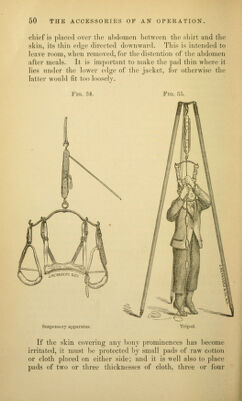
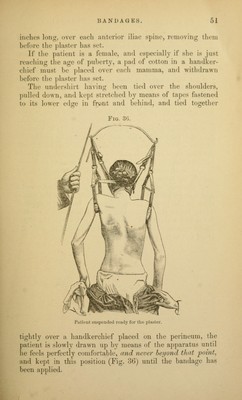
![splint without covering tlie liuib t-ntirely, is one in general use in the Paris hospitals. A strip of crinoline, folded in six or eight thicknesses of the proper length and breadth, is dniwn through the liquid plaster, stripped down rapidly to remove the excess, applied to the limb, and fixed with a few- turns of an onlinarv roller banda^re. Instead of a sintrle strip two may be used and applied on opposite sides of the limb. Such a splint fits the limb accurately, and will not make undue pressure at *iny point. Sayre's Plaster of Paris Jacket}—In connection with this subject, and in view of the importance and recent origin of this method of treating spinal disease, it ha.s been thought proper to add a description of the method of applying the Plaster of Paris jacket. The bandacres are made of strips of crinoline three vards long and from two and a half to tliree inches wide, accord- ing to the size of the patient, filled with dry plaster as before described, and put up in rolls which are moistened by setting them on end in a basin of water just before they are to be applied. For the purpose of strengthening the jacket and diminishing the amount of plaster required, narrow strips of tin, roughened on both sides like a nutmeg grater, are placed longitudinally around the body at inter- vals of two or three inches between the turns of the plaster bandage. The skin should be protected by an elastic, closely fitting undei^shirt of some soft woven or knitted material, without arms, but with tabs to tie over the shoulders. As it is difficult for an assistant to hold the patient sus- pended during the application of the dressing, the apparatus shown in Fig. 34 has been devised. It consists of a curved iron cross-bar, to which are attached an adjustable head and chin collar and axillaiy bands. To a hook in the centre is attached a compound pulley, the other end of which is secured either to a hook in the ceiling or to the top of a tripod eight or ten feet high (Fig. 35). The collar and bands having been carefully adjusted, the patient is drawn up until the feet swing clear of the floor, and a wedge-sha]»e<l pad of raw cotton folded in a handker- ^ Spinal Disease and Spinal Curvature, by Prof. L. A. Sayre, 1877. 5](https://iiif.wellcomecollection.org/image/b21206533_0055.jp2/full/800%2C/0/default.jpg)
 No text description is available for this image
 No text description is available for this image
 No text description is available for this image