Treatise on human physiology : for the use of students and practitioners of medicine / by Henry C. Chapman.
- Henry Cadwalader Chapman
- Date:
- 1887
Licence: Public Domain Mark
Credit: Treatise on human physiology : for the use of students and practitioners of medicine / by Henry C. Chapman. Source: Wellcome Collection.
103/942 page 115
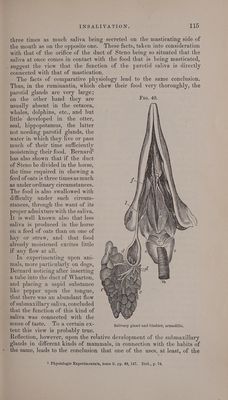
![three times as much saliva being secreted on the masticating side of the mouth as on the opposite one. These facts, taken into consideration with that of the orifice of the duct of Steno being so situated that the saliva at once comes in contact with the food that is being masticated, _suggest the view that the function of the parotid saliva is directly connected with that of mastication. The facts of comparative physiology lead to the same conclusion. Thus, in the ruminantia, which chew their food very thoroughly, the parotid glands are very large; on the other hand they are Bia. 40. usually absent in the cetacea, ] whales, dolphins, etc., and but little developed in the otter, seal, hippopotamus, the latter not needing parotid glands, the water in which they live or pass much of their time sufficiently moistening their food. Bernard’ has also shown that if the duct of Steno be divided in the horse, the time required in chewing a feed of oats is three timesas much as under ordinary circumstances. The food is also swallowed with dificulty under such circum- stances, through the want of its proper admixture with the saliva. It is well known also that less saliva is produced in the horse on a feed of oats than on one of hay or straw, and: that food already moistened excites little if any flow at all. In experimenting upon ani- mals, more particularly on dogs, | Bernard noticing after inserting gj a tube into the duct of Wharton, and placing a sapid substance like pepper upon the tongue, ¢ | that there was an abundant flow of submaxillary saliva, concluded that the function of this kind of Saliva was connected with the sense of taste. ‘T'o a certain ex- Salivary gland and bladder, armadillo, tent this view is probably true. Reflection, however, upon the relative development of the submaxillary glands in different kinds of mammals, in connection with the habits of - the same, leads to the conclusion that one of the uses, at least, of the ) { i] Dh =. _ NN 1 Physiologie Experimentale, tome ii. pp. 49, 147. Ibid., p. 74.](https://iiif.wellcomecollection.org/image/b33764669_0103.jp2/full/800%2C/0/default.jpg)
 No text description is available for this image
 No text description is available for this image
 No text description is available for this image