Treatise on human physiology : for the use of students and practitioners of medicine / by Henry C. Chapman.
- Henry Cadwalader Chapman
- Date:
- 1887
Licence: Public Domain Mark
Credit: Treatise on human physiology : for the use of students and practitioners of medicine / by Henry C. Chapman. Source: Wellcome Collection.
79/942 page 91
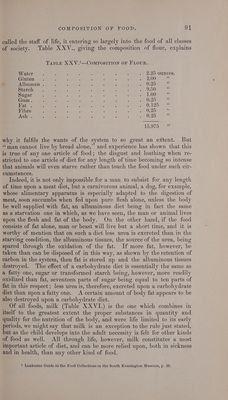
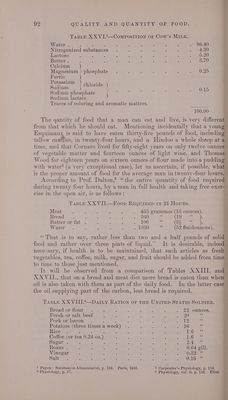
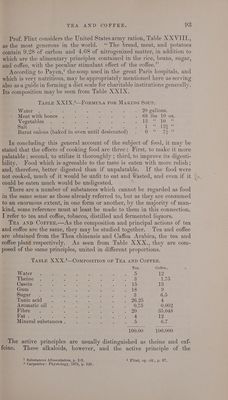
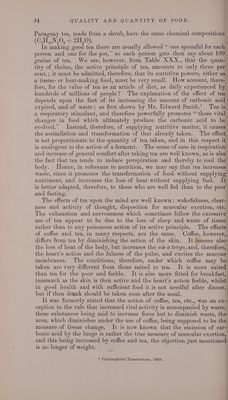
![called the staff of life, it entering so largely into the food of all classes of society. Table XXV., giving the composition of flour, explains TABLE XX V.!—COMPOSITION OF FLOUR. Water Gluten Albumen . Starch Sugar Gum. Fat: % Fibre Ash . CHa Se he] — Or ito) “I foo) | why it fulfils the wants of the system to so great an extent. But ‘man cannot live by bread alone,” and experience has shown that this is true of any one article of food; the disgust and loathing when re- stricted to one article of diet for any length of time becoming so intense that animals will even starve rather than touch the food under such cir- cumstances. Indeed, it is not only impossible for a man to subsist for any length of time upon a meat diet, but a carnivorous animal, a dog, for example, whose alimentary apparatus is especially adapted to the digestion of meat, soon succumbs when fed upon pure flesh alone, unless the body be well supplied with fat, an albuminous diet being in fact the same as a Starvation one in which, as we have seen, the man or animal lives upon the flesh and fat of the body. On the other hand, if the food consists of fat alone, man or beast will live but a short time, and it is worthy of mention that on such a diet less urea is excreted than in the starving condition, the albuminous tissues, the source of the urea, being spared through the oxidation of the fat. If more fat, however, be taken than can be disposed of in this way, as shown by the retention of carbon in the system, then fat is stored up and the albuminous tissues destroyed. ‘The effect of a carbohydrate diet is essentially the same as a fatty one, sugar or transformed starch being, however, more readily oxidized than fat, seventeen parts of sugar being equal to ten parts of fat in this respect ; less urea is, therefore, excreted upon a carbohydrate diet than upon a fatty one. A certain amount of body fat appears to be also destroyed upon a carbohydrate diet. Of all foods, milk (Table XXVI.) is the one which combines in itself to the greatest extent the proper substances in quantity and quality for the nutrition of the body, and were life limited to its early periods, we might say that milk is an exception to the rule just stated, but as the child develops into the adult necessity is felt for other kinds of food as well. All through life, however, milk constitutes a most important article of diet, and can be more relied upon, both in sickness and in health, than any other kind of food. 1 Lankester Guide to the Food Collections in the South Kensington Museum, p. 39.](https://iiif.wellcomecollection.org/image/b33764669_0079.jp2/full/800%2C/0/default.jpg)
 No text description is available for this image
 No text description is available for this image
 No text description is available for this image