Treatise on human physiology : for the use of students and practitioners of medicine / by Henry C. Chapman.
- Henry Cadwalader Chapman
- Date:
- 1887
Licence: Public Domain Mark
Credit: Treatise on human physiology : for the use of students and practitioners of medicine / by Henry C. Chapman. Source: Wellcome Collection.
826/942 page 838
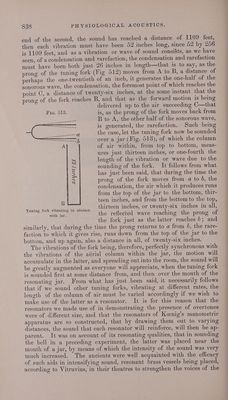
![end of the second, the sound has reached a distance of 1109 feet, then each vibration must have been 52 inches long, since 52 by 256. is 1109 feet, and asa vibration or wave of sound consists, as we have seen, of a condensation and rarefaction, the condensation and rarefaction must have been both just 26 inches in length—that 1s to say, as the prong of the tuning fork (Fig 512) moves from A to B, a distance of perhaps the one-twentieth of an inch, it generates the one-half of the sonorous wave, the condensation, the foremost point of which reaches the point C, a distance of twenty-six inches, at the some instant that the prong of the fork reaches B, and that as the forward motion is being delivered up to the air succeeding C—that Fie. 513. is, as the prong of the fork moves back from B to A, the other half of the sonorous wave, is generated, the rarefaction. Such being the case, let the tuning fork now be sounded over a jar (Fig. 513), of which the column of air within, from top to bottom, meas- ures just thirteen inches, or one-fourth the length of the vibration or wave due to the sounding of the fork. It follows from what has just been said, that during the time the prong of the fork moves from a to 6, the condensation, the air which it produces runs 3 from the top of the jar to the bottom, thir- B teen inches, and from the bottom to the top, are rR ST thirteen inches, or twenty-six inches in all, e@ fork vibrating in uinison : ith jar. the reflected wave reaching the prong of the fork just as the latter reaches 6; and similarly, that during the time the prong returns to a from b, the rare- faction to which it gives rise, runs down from the top of the jar to the bottom, and up again, also a distance in all, of twenty-six inches. The vibrations of the fork being, therefore, perfectly synchronous with the vibrations of the aérial column within the jar, the motion will accumulate in the latter, and spreading out into the room, the sound will be greatly augmented as everyone will appreciate, when the tuning fork is sounded first at some distance from, and then over the mouth of the resonating jar. From what has just been said, it necessarily follows that if we sound other tuning forks, vibrating at different rates, the length of the column of air must be varied accordingly if we wish to make use of the latter as a resonator. It is for this reason that the resonators we made use of in demonstrating the presence of overtones were of different size, and that the resonators of Koenig’s manometric apparatus are so constructed, that by drawing them out to varying distances, the sound that each resonator will reinforce, will then be ap- parent. It was on account of its resonating qualities, that in sounding the bell in a preceding experiment, the latter was placed near the mouth of a jar, by means of which the intensity of the sound was very much increased. The ancients were well acquainted with the efhcacy of such aids in intensifying sound, resonant brass vessels being placed, according to Vitruvius, in their theatres to strengthen the voices of the SIYIU] Ef](https://iiif.wellcomecollection.org/image/b33764669_0826.jp2/full/800%2C/0/default.jpg)
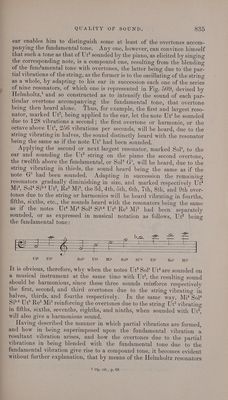
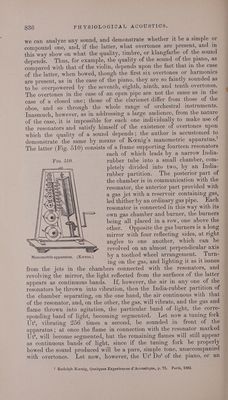
 No text description is available for this image
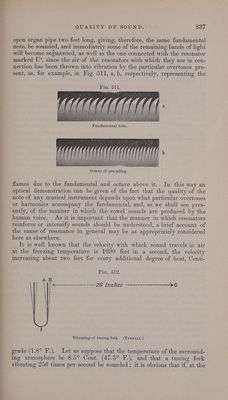
 No text description is available for this image
 No text description is available for this image