Treatise on human physiology : for the use of students and practitioners of medicine / by Henry C. Chapman.
- Henry Cadwalader Chapman
- Date:
- 1887
Licence: Public Domain Mark
Credit: Treatise on human physiology : for the use of students and practitioners of medicine / by Henry C. Chapman. Source: Wellcome Collection.
870/942 page 882
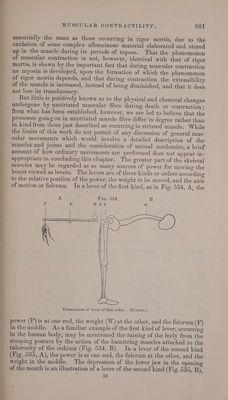
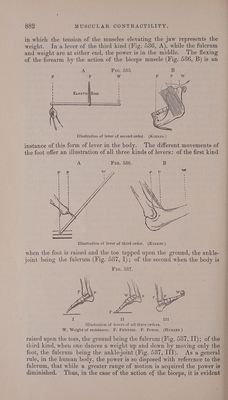
![in which the tension of the muscles elevating the jaw represents the weight. Ina lever of the third kind (Fig. 536, A), while the fulcrum and weight are at either end, the power is in the middle. The flexing of the forearm by the action of the biceps muscle (Fig. 536, B) is an A Fira. 535. Ra* Ws F J J ! J 1 | i] RB Illustration of lever of second order. (KIRKES.) instance of this form of lever in the body. The different movements of the foot offer an illustration of all three kinds of levers: of the first kind A Fig. 586. B Illustration of lever of third order. (K1iRKES.) when the foot is raised and the toe tapped upon the ground, the ankle- joint being the fulcrum (Fig. 587, I); of the second when the body is Fie. 537. Jllustration of levers of all three orders. W. Weight of resistance. F. Fulcrum. P. Power. (Hux ey.) raised upon the toes, the ground being the fulcrum (Fig. 587, IT); of the third kind, wheu one dances a weight up and down by moving only the foot, the fulerum being the ankle-joint (Fig. 587, III). As a general rule, in the human body, the power is so disposed with reference to the fulcrum, that while a greater range of motion is acquired the power is diminished. ‘Thus, in the case of the action of the biceps, it is evident](https://iiif.wellcomecollection.org/image/b33764669_0870.jp2/full/800%2C/0/default.jpg)
 No text description is available for this image
 No text description is available for this image
 No text description is available for this image