Treatise on human physiology : for the use of students and practitioners of medicine / by Henry C. Chapman.
- Henry Cadwalader Chapman
- Date:
- 1887
Licence: Public Domain Mark
Credit: Treatise on human physiology : for the use of students and practitioners of medicine / by Henry C. Chapman. Source: Wellcome Collection.
885/942 page 897
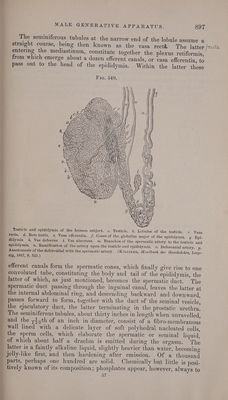
![The seminiferous tubules at the narrow end of the lobule assume a entering the mediastinum, constitute together the plexus retiformis, from which emerge about a dozen efferent canals, or vasa efferentia, to pass out to the head of the epididymis. Within the latter these Testicle and epididymis of the human subject. a. Testicle. b. Lobules of the testicle. c Vasa recta. d. Rete testis, e. Vasa efferentia. f Cones of the globulus major of the epididymis. g Epi- didymis. h. Vas deferens. 4, Vas aberrans. m. Branches of the spermatic artery to the testicle and epididymis, ». Ramification of the artery upon the testicle and epididymis. 0. Deferential artery. p. Anastomosis of the deferential with the spermatic artery. (KititKer, Handbuch der Gewebelehre, Leip- zig, 1867, S. 523.) efferent canals form the spermatic cones, which final] y give rise to one convoluted tube, constituting the body and tail of the epididymis, the latter of which, as just mentioned, becomes the spermatic duct. The spermatic duct passing through the inguinal canal, leaves the latter at the internal abdominal ring, and descending backward and downward, passes forward to form, together with the duct of the seminal vesicle, the ejaculatory duct, the latter terminating in the prostatic urethra. The seminiferous tubules, about thirty inches in length when unravelled, and the z45th of an inch in diameter, consist of a fibro-membranous wall lined with a delicate layer of soft polyhedral nucleated cells, the sperm cells, which elaborate the spermatic or seminal liquid, of which about half a drachm is emitted during the orgasm. ‘The latter is a faintly alkaline liquid, slightly heavier than water, becoming parts, perhaps one hundred are solid. Chemically but little is posi- tively known of its composition; phosphates appear, however, always to 57](https://iiif.wellcomecollection.org/image/b33764669_0885.jp2/full/800%2C/0/default.jpg)
 No text description is available for this image
 No text description is available for this image
 No text description is available for this image