[Report 1948] / Medical Officer of Health, Cumberland County Council.
- Cumberland County Council
- Date:
- 1948
Licence: Attribution 4.0 International (CC BY 4.0)
Credit: [Report 1948] / Medical Officer of Health, Cumberland County Council. Source: Wellcome Collection.
4/98 page 4
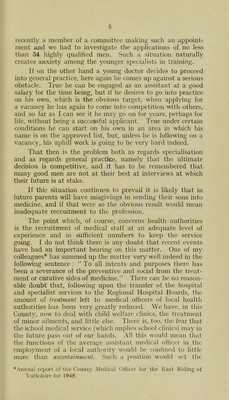
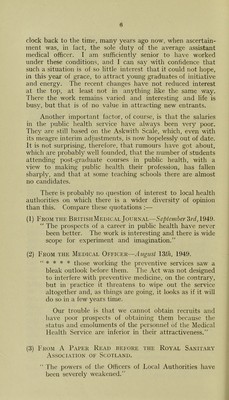
![The hospital and specialist services have, on paper, passed completely out of our hands as a Health Authority, but we still retain close links with both, and as I have said later, I hope these links will be developed and extended. Vital Statistics. Vital statistics for 1948 call for little comment. The birth-rate has fallen in conformity with the rest of the country. The death-rate has also fallen, and particularly the infantile death-rate, which has fallen from 42 per 1,000 live births to 37. The maternal death-rate has, unhappily, risen ; deaths from cancer are slightly lower ; deaths from pulmonary tuberculosis are higher. That, I think, is all that needs to be said here about the principal vital statistics which are discussed in more detail in other parts of this report. The future of the Public Health Medical Service. Over the whole future of medicine there hangs, if not the sword of Damocles, at least a big question mark. This does not, in the main, affect those matters which formed the basis of so much controv'ersy prior to the passing of the National Health Service Act; it concerns something quite different which perhaps could not have been foreseen by anyone. The situation is this. When a young graduate in medicine leaves his university he has a wide choice of activity before him. He may enter the government service, or the local government service, he may accept a permanent commission in one or other of the forces, he may enter the colonial service, and so on, but in the main his choice lies between general practice and specialisation. In both of these branches of medicine the immediate prospects are good, and very much better than the prospects for young graduates were a few years ago. From the long term point of view, however, the situation is not so good. If a young doctor desires to specialise, and is approved for specialisation, in due course he becomes a registrar, and there are several grades of registrars who are, in fact specialists in training. The trouble is that on com- ])letion of a number of years, about six to eight, in the registrar grade, he may, unless he is successful in obtaining a post in the specialist grade, become redundant, and may have to transfer to general practice or some other branch of medicine. Appointments of specialists to posts in the hospital service are generally the subject of hot competition. I was](https://iiif.wellcomecollection.org/image/b2913304x_0006.jp2/full/800%2C/0/default.jpg)