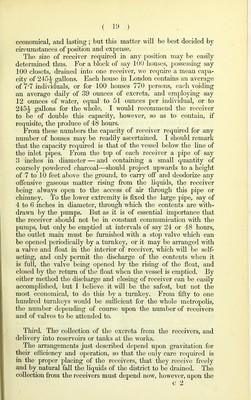
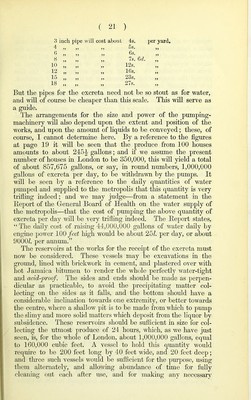
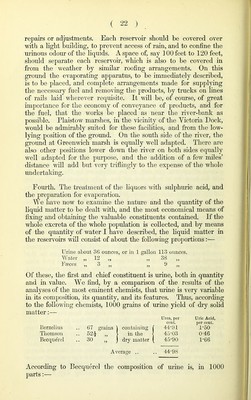
Town excreta, its utilization : London sewage, shall it be wasted? or economised? : being a plan for the collection and treatment of the faecal matter of towns, for purifying the sewers and rivers, and removing the chief impurities which render them dangerous to the health of communities : with especial and immediate reference to the metropolis, the River Thames, and the Board of Works' main drainage scheme / by Charles F.O. Glassford.
- Glassford, Charles F.O.
- Date:
- 1858
Licence: Public Domain Mark
Credit: Town excreta, its utilization : London sewage, shall it be wasted? or economised? : being a plan for the collection and treatment of the faecal matter of towns, for purifying the sewers and rivers, and removing the chief impurities which render them dangerous to the health of communities : with especial and immediate reference to the metropolis, the River Thames, and the Board of Works' main drainage scheme / by Charles F.O. Glassford. Source: Wellcome Collection.
Provider: This material has been provided by The Royal College of Surgeons of England. The original may be consulted at The Royal College of Surgeons of England.
23/32 (page 23)
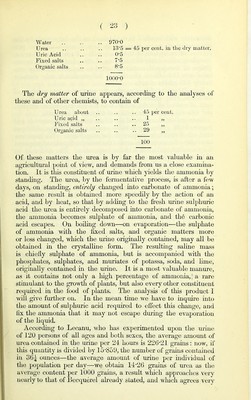
![Water .. 970-0 U rea 13-5 Uric Acid 0-5 Fixed salts 7-5 Organic salts 8-5 1000-0 The dry matter of urine appears, according to the analyses of these and of other chemists, to contain of Urea about Uric acid „ Fixed salts Organic salts 100 45 per cent. 1 „ 25 „ 29 Of; these matters the urea is by far the most valuable in an agricultural point of view, and demands from us a close examina- tion. It is tliis constituent of urine which yields the ammonia by standing. The urea, by the fermentative process, is after a few days, on standing, entirely changed into carbonate of ammonia; the same result is obtained more speedily by the action of an acid, and by heat, so that by adding to the fresh mine sulphuric acid the urea is entirely decomposed into carbonate of ammonia, the ammonia becomes sulphate of ammonia, and thb carbonic acid escapes. On boiling down—on evaporation—the sulphate of ammonia with the fixed salts, and organic matters more or less changed, which the urine originally contained, may all be obtained in the crystalline form. The resulting saline mass is chiefiy sulphate of ammonia, but is accompanied with the phosphates, sulphates, and muriates of potassa, soda, and lime, originally contained in the urine. It is a most valuable manure, as it contains not only a high percentage of ammonia, ] a rare stimulant to the growth of plants, but also every other constituent required in the food of plants. The analysis of this product 1 will give further on. In the mean tune we have to inquire into the amount of sulphuric acid required to effect this change, and fix the ammonia that it may not escape during the evaporation of the liquid. According to Lecanu, who has experimented upon the urine of 120 persons of all ages and both sexes, the average amount of urea contained in the urine per 24 hours is 226-21 grains: now, if this quantity is divided by 15-859, the number of grains contained in 36^ ounces—the average amount of urine per individual of the population per day—we obtain 14-26 grains of urea as the average content per 1000 grains, a result which approaches very nearly to that of Becqucrel already stated, and which agrees very](https://iiif.wellcomecollection.org/image/b22348724_0025.jp2/full/800%2C/0/default.jpg)