A manual of practical hygiene / by Edmund A. Parkes ; edited by F.S.B. Francois de Chaumont.
- Date:
- 1878
Licence: Public Domain Mark
Credit: A manual of practical hygiene / by Edmund A. Parkes ; edited by F.S.B. Francois de Chaumont. Source: Wellcome Collection.
Provider: This material has been provided by the Royal College of Physicians of Edinburgh. The original may be consulted at the Royal College of Physicians of Edinburgh.
126/820 (page 84)
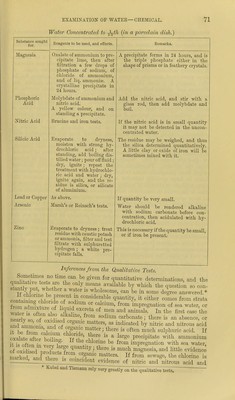
![110 to 120 C.C. distilled off. It is sometimes convenient to add a little pure distilled water to the residue if the first distillation has heen carried rather far. Wanklyn recommends successive quantities of 50 C.C. to he distdled off and tested until no more ammonia comes over. Determine the amount of ammonia, as was done in the case of the free ammonia, and state the results in this case as albuminoid ammonia. In this distillation there is sometimes a little difficulty caused by bumping, especially in the case of bad waters: to remedy this it has been recommended to use pieces of tobacco pipe or charcoal.* It is better, however, to dUute the water if it be a bad one, and not to distU too rapidly. A good deal of controversy has taken place as to the significance of this test, some chemists denying that all the nitrogen is obtained. Wanklyn, however, insists that what is obtained is a constant quantity, and that ten times the ammonia represents fairly accurately the nitrogenous organic matter. Although it may not be perfectly accurate, it seems better adapted for hygienic purposes than Frankland's method, which requires apparatus of a complicated and costly character, besides being liable to wide limits of error. With Wanldyn's process a bad water is not likely to escape detection,—in the words of Hassall, a bad water will appear bad, and a good water wdl appear good, although the absolute quantities of organic matter cannot be thus determined. (Adulterations Detected, 1876, p. 82.) The standard limit of albuminoid ammonia in good water is 0-08 milligrammes per litre, but Wanklyn thinks anything above 0-05 objection- able if the free ammonia be large. He classifies waters into three classes,! viz. :—Class I, waters of extraordinary organic purity, containing from 0-00 to 0-05 of albuminoid ammonia. Class II. comprehends the general drinking- waters of this country, giving from 0-05 to 0d0 of albuminoid ammonia. Such water is safe organically. Class III, the dirty waters, yielding more than 0-10 of albuminoid ammonia. This last seems to be rather too sweep- ing a statement. Although animal matter is the chief source of dbuminoid ammonia, it may be yielded by vegetable as well. Decaying leaves produce it (Parkes), also peat (Dearing, Abel, Thorp, EusseU). Much albuminoid ammonia (which generally comes over slowly), little free ammonia, and almost entire absence of chlorides, is indicative of vegetable contamination. (Wanklyn). In the Leek workhouse persons drinking such a water (free ammonia 0-02, albuminoid 0-34) suffered from diarrhoea. There was only 0-5 grains of chlorine per gallon. In the water of a pond in Perthshire I found: free ammonia 0-36, albuminoid 2-00 milligrammes per litre, and chlorine only 0-62 grains per gallon. This had been used for many years without any bad effects observed. (P. de C.) In well-waters in villages there is often a large amount of albuminoid i ammonia.J Wanklyn found in the Thames at Hampton Court 0-28, at; London Bridge at high tide 0-59. Dr Palmer found the tank water in. Calcutta to vary accovdiug to the time.of year and amount of rain, the greatest: impurity being in May and June, the hottest and driest time. The tank. supplying the Bengal Club showed in November 0-38, in May 0-50 and in June 0-62. The water of the Hooghly, 16 miles above Calcutta, had i December 0-10, in May 0T4, and in June 0T0. It has sometimes been suggested to distd off at once the total ammonia b the process with permanganate and potash. Dr Macnamara mentions tha this was done daily in Calcutta for a considerable time, and that by its * Both must be heated to redness immediately before use. J^ForVxamplefl, *ee my Lectures on State Medicine, p. 73, table xii. [F. de C]](https://iiif.wellcomecollection.org/image/b21932992_0126.jp2/full/800%2C/0/default.jpg)