A manual of practical hygiene / by Edmund A. Parkes ; edited by F.S.B. Francois de Chaumont.
- Date:
- 1878
Licence: Public Domain Mark
Credit: A manual of practical hygiene / by Edmund A. Parkes ; edited by F.S.B. Francois de Chaumont. Source: Wellcome Collection.
Provider: This material has been provided by the Royal College of Physicians of Edinburgh. The original may be consulted at the Royal College of Physicians of Edinburgh.
271/820 (page 225)
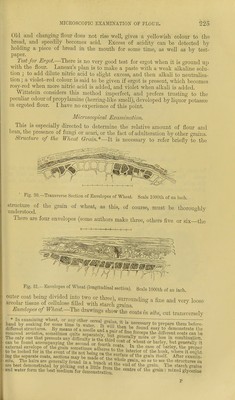
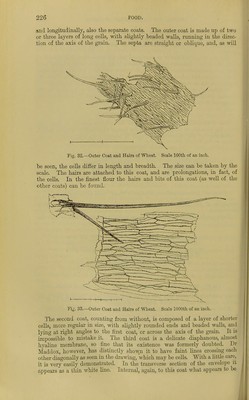
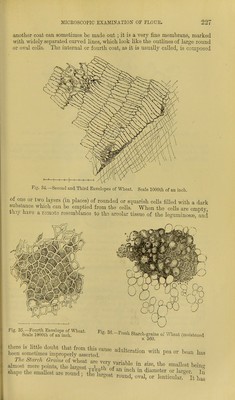
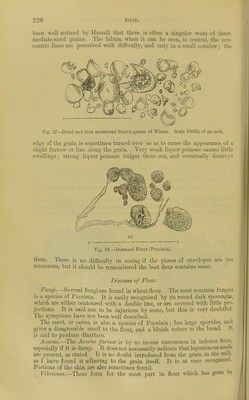
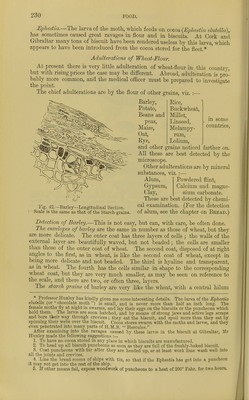
![Old and changing flour does not rise well, gives a yellowish colour to the bread, and speedily becomes acid. Excess of acidity can be detected by holding a piece of bread in the mouth for some time, as well as by test- paper. Test for Ergot.—There is no very good test for ergot when it is ground up with the flour. Laneau's plan is to make a paste with a weak alkaline solu- tion ■ to add dilute nitric acid to slight excess, and then alkali to neutralisa- tion ; a violet-red colour is said to be given if ergot is present, which becomes rosy-red when more nitric acid is added, and violet when alkali is added. Wittstein considers this method imperfect, and prefers trusting to the peculiar odour of propylamine (herring-like smell), developed by liquor potassa? in ergoted flour. I have no experience of this point. Microscopical Examination. This is especially directed to determine the relative amount of flour and bran, the presence of fungi or acari, or the fact of adulteration by other grains. Stmcture of the Wheat Grain.*—It is necessary to refer briefly to the Fig. 30.—Transverse Section of Envelopes of Wheat. Scale 1000th of an inch. structure of the grain of wheat, as this, of course, must be thorouo-hlv understood. ° J There are four envelopes (some authors make three, others five or six—the H 1—1 Fig. Si-Envelopes of Wheat (longitndinal section). Scale 1000th of an inch. outer coat being divided into two or three) surrminrlinr, n a, „ i i areolar tissue of cellulose filled with 32 g ^ l008° Envelopes of meat—The dj^^w^^in^^ cut transversely « In examining wheat, or any other cereal erains it i. I « ; hand by soaking for some time in water It will V/ 18,nec,essaTy to prepare them before- different structures. By means of a needle and a mir f « * ul easy to demonstrate t!l^' removed seriatim,, sometimes quite separately bnf o forceps the different coats can bo The only one that presents any difficulty is theSe<>enilly more or less in combination, can be found accompanying the second or fourth fio^S t !^uM m h&t}*?> !,ut orally » external envelope of the grain sometimes adhere t«ti • In • 0 case of barley> tlje proper to be looked for in the event of its notbeW ontL», ? mtT?T of tbe husk' where & ing the separate coats, sections may be made of rh« , , aco of t],e Rlai» Itself. After examin- situ. The hairs are generally found in a bunch .t HT V*?> 80 ns to sue t,lc stretnres in are best demonstrated by pickinc out i HtfE rL, 110 md of t,l° Srain- Tlle starch grains and water form the best aeol^CaeVonstSoS C6ntre of th° graiu: mixed SW»](https://iiif.wellcomecollection.org/image/b21932992_0271.jp2/full/800%2C/0/default.jpg)