A manual of practical hygiene / by Edmund A. Parkes ; edited by F.S.B. Francois de Chaumont.
- Date:
- 1878
Licence: Public Domain Mark
Credit: A manual of practical hygiene / by Edmund A. Parkes ; edited by F.S.B. Francois de Chaumont. Source: Wellcome Collection.
Provider: This material has been provided by the Royal College of Physicians of Edinburgh. The original may be consulted at the Royal College of Physicians of Edinburgh.
732/820 (page 676)
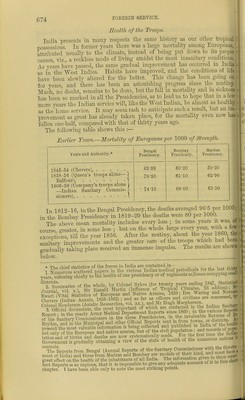
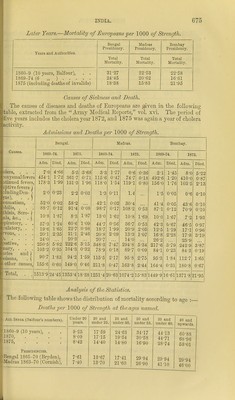
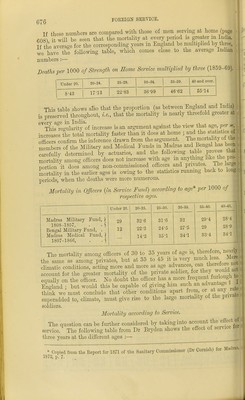
![If these numbers are compared with those of men serving at home (page fi(M it will be seen that the mortality at every period is greater in India. Tf the average for the corresponding years in England be multiplied by three, we have the following table, which comes close to the average Indian numbers :— Deaths per 1000 of Strength on Rome Service multiplied by three (1859-69). Under 20. 20-24. 25-29. 30-34. 85-39. 40 and over. 8-43 17-13 22-83 36-99 46-62 55-14 This table shows also that the proportion (as between England and India) is preserved throughout, i.e., that the mortality is nearly threefold greater at everv age in India. . , This regularity of increase is an argument against the view that age, per se, increases the total mortality faster than it does at home ; and the statistics o ; officers confirm the inference drawn from the argument. The mortality of the ■ members of the Military and Medical Eunds in Madras and Bengal has been , carefidly determined by actuaries, and the following table proves that mortality among officers does not increase with age m anything like> thepro- portion it does among non-commissioned officers and privates The large | mortality in the earlier ages is owing to the statistics running back to long periods, when the deaths were more numerous. Mortality in Officers (in Service Fund) according to age* per 1000 of respective ages. Under 20. 20-25. 25-30. 30-35. 35-40. 40-45. ' Madras Military Fund, ] 1808-1857, . . < Bengal Military Fund, . Madras Medical Fund, 1807-1866, 29 12 32-6 22-3 14-2 31-6 24-5 35-1 32 27-5 34-1 29-4 29 33-4 28-4 | 2S-9 , 34-1 j The mortality among omcers 01 e>v to ou yeais uo. ^ , _ . the same as among privates, but at 35 to 45 it is very . climatic conditions, acting more and more as age advances can theiefoie ntf account for the greater mortality of the private soldierfor they. ™^ °« equally on the officer. No doubt the officer has a more frequent fuilough to England ; but would this be capable of giving him such an advantage II think we must conclude that other conditions apart from, or at any.raw superadded to, climate, must give rise to the large mortality of the private soldiers. Mortality according to Service. The question can be further considered by taking into account the effect of service. The following table from Dr Bryden shows the effect of service tor three years at the different ages :— * Copied from the Report for 1871 of the Sanitary Commissioner (Dr Cornish) for Madras, 1872, p. 7.](https://iiif.wellcomecollection.org/image/b21932992_0732.jp2/full/800%2C/0/default.jpg)