A tour in Ireland; with general observations on the present state of that kingdom made in the years 1776, 1777, and 1778. And brought down to the end of 1779 / By Arthur Young.
- Arthur Young
- Date:
- 1780
Licence: Public Domain Mark
Credit: A tour in Ireland; with general observations on the present state of that kingdom made in the years 1776, 1777, and 1778. And brought down to the end of 1779 / By Arthur Young. Source: Wellcome Collection.
580/588 page 168
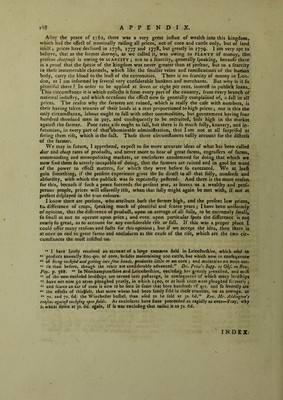
![After the peace of 1762, there was a very great influx of wealth into this kingdom, which had the efFedl of nominally raifing all prices, not of corn and cattle only, but of land itfelf ; prices have declined in 1776, 1777 and 1778, but greatly in 1779. I am very apt to believe, that as the former dearnej]^ as we called it, was owing to plenty of money, thei cheapnefs is owing to scarcity; not to a fcarcity, generally fpeaking, becaufe there is a proof that the fpecie of the kingdom was never greater than at prefent, but to a fcarcity in thefe innumerable channels, which like the fmaller veins and ramifications of the human body, carry the blood to the leaft of the extremities. There is no fcarcity of money in Lon- don, as I am informed by feveral very confiderable bankers and merchants. But why is it fo plentiful there ? In order to be applied at feven or eight per cent, intereft in publick loans. This circumftance it is which colledts it from every part of the country, from every branch of national induftry, and which occafions the effeiSlnow fo generally complained of, a fall in all prices. The reafon why the farmers are ruined, which is really the cafe with numbers, is their having taken tenures of their lands at a rent proportioned to high prices ; nor is this the only circumftance, labour ought to fall with other commodities, but government having four hundred thoufand men in pay, and confequently to be recruited, bids high in the market againft the farmer. Poor rates alfo ought to fall, but there is fo much foHy, knavery, and in- fatuation, in every part of that^bominable adminiftration, that I am not at all furprifed at feeing them rife, which is the fa£k. Thefe three eircumftances eafily account for the diftrefs of the farmer. We may in future, I apprehend, expedl to fee more accurate ideas of what has been called dear and cheap rates of products, and never more to hear of great farms, engroflers of farms, commanding and monopolizing markets, or enclofures condemned for doing that which we now find them fo utterly incapable of doing, that the farmers are ruined and in gaol for want of the power to effeft matters, for which they were before fo execrated. We at leaft gain fomething, if the prefent experience gives the lie direct to all that folly, nonfenfe and abfurdity, with which the publick was fo repeatedly peftered. And there is the more reafon for this, becaufe if fuch a peace fucceeds the prefent jvar, as leaves us a wealthy and prof- perous people, prices will afTuredly rife, when that folly might again be met with, if not at prefent difplayed in the true colours. I know there are perfons, who attribute both the former high, and the prefent low prices, ta difference of crops, fpeaking much of plentiful and fcarce years ; I have been uniformly of opinion, that the difference of produdf, upon an average of all foils, to be extremely fmall, fo fmall as not to operate upon price ; and even’ upon particular fpots the difference is not nearly fo great, as to account for any confiderable rife or fall. If this was a proper place I could offer many rcafons and facts for this opinion ; but if we accept the idea, then there is at once an end to great farms and enclofures as the caufe of the rife, which are the two cir- cumftances the molt infifted on. '• I have lately received an accoont of a large common field in Leicefterftiire, which ofed to produce annually 800 qrs. of corn, befides maintaining 200 cattle, but which now in confequence ** of being inclofed and getting into Je-iu hands, produces little or no corn ; and maintains no more cat- “ tie than before, though the rents are considerably advanced.” Dr. Price's Supp. to Ob/, on Rev. Pay. p. 388. In Northampionfliire and Leicefterftiire, enclofing has greatly prevailed, and moll “ of the new enclofed lordlhips are tamed into pallurage, in confequence of which many lordlhipi ** have not now 50 acres ploughed yearly, in which 1500, or at leaft 1000 were ploughed formerly ; “ and fcarce an ear of corn is now to be feen in fome that bore hundreds of qrs. and fo feverely are the elFedls of thislfelt, that more wheat had been lately fold in thefe counties, on an average, at 7s. and 7s. 6d. the Winchefter buftiel, than ufed to be fold at 3s. 6d.” Rev. Mr. Addington's reafons againjl enclojing open fields. As enclofures have fince proceeded as rapidly as ever—Pray, why is wheat down at 3s. 6a. again, if it was enclofing that raifed it to 7s, 6d. INDEX.](https://iiif.wellcomecollection.org/image/b28759072_0580.jp2/full/800%2C/0/default.jpg)