On the aims and philosophic method of pathological research : an inaugural address delivered at St. Thomas's Hospital, December 15th, 1847 / by John Simon.
- Date:
- [1847]
Licence: Public Domain Mark
Credit: On the aims and philosophic method of pathological research : an inaugural address delivered at St. Thomas's Hospital, December 15th, 1847 / by John Simon. Source: Wellcome Collection.
Provider: This material has been provided by the Royal College of Physicians of Edinburgh. The original may be consulted at the Royal College of Physicians of Edinburgh.
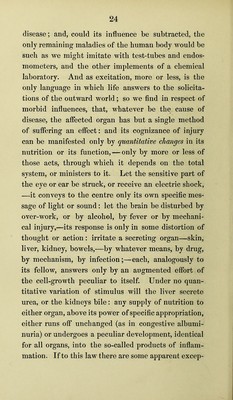
23/56 page 23
![we have no more hesitation in naming the cause, than if we had the minerals precipitated in a test- tube. Equally precise is the elective affinity of morbid poisons, which indeed we recognise and dis- tinguish only by their specific attractions. In the abdominal flooding of cholera, in the coughing and sneezing and sniveling of influenza, in the eruption of the exanthematous fevers, we see the human body yielding uniform local phenomena to the ex- citement of specific causes, with just as much con- stancy as is found in the reactions of brute matter; and the evidence, that various diseases have their specific ranges of affinity, is just as clear as that de- monstration of a chemical attraction which we find in the precipitation of sulphate of baryta, or the combustion of phosphorus. The second law to which I have referred is of no less importance. While we find an infinite variety in those influences from the outward world by which man is affected : while v/e find that the causes of disease are innumerable; (destructive violence, me- chanical or chemical; atmospheric variations; irre- gular nourishment; the over-excitement or desue- tude of organs; parasitic invasion; the infection of morbid poisons;) how remarkable a contrast do we see between this variety of causes and the simplicity of their organic effects! the singleness of life and living reaction opposed to the multiplicity of exte- rior contact! For, as excitability is the test and token of animal life, so is it by this function only that life becomes ])articipant in the production of](https://iiif.wellcomecollection.org/image/b21953077_0025.jp2/full/800%2C/0/default.jpg)

 No text description is available for this image
 No text description is available for this image
 No text description is available for this image