Catalogue of the Hunterian collection in the Museum of the Royal College of Surgeons in London.
- Royal College of Surgeons in London. Museum
- Date:
- 1830-1831
Licence: Public Domain Mark
Credit: Catalogue of the Hunterian collection in the Museum of the Royal College of Surgeons in London. Source: Wellcome Collection.
Provider: This material has been provided by The University of Glasgow Library. The original may be consulted at The University of Glasgow Library.
121/764 page 5
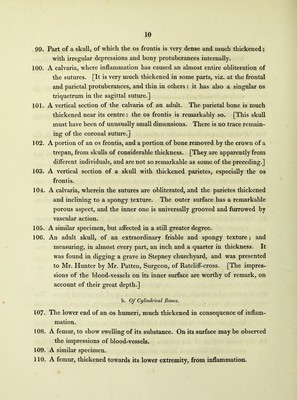
![42. A transverse section of a fractured femur. The broken ends having united laterally, the medullary canal, in consequence, is not filled up by the callus at the point of union. 43. A portion of tibia, showing a fracture near its middle, which has been firmly united without much distortion. 44. A tibia and fibula which have been fractured; the tibia near the lower, the fibula near the upper extremity, as is generally the case. The fractures have been well united. 45. A similar specimen. [Both the tibia and fibula have been splintered, but the splinters are firmly united; and must, from their position, have aiforded considerable support to the limb, during its progress towards recovery.] 46. Two longitudinal sections of a tibia which had suffered a compound fracture near its lower extremity. [No. 66 Pathological Preparation in Spirit, is a section removed from between these two portions : and it is there stated that “ the sore never healed, nor could the man bear any weight on the limb, in consequence of the two portions of the bone having united by so small a surface. The leg was amputated on that account.”] 47. A fibula, with an unusually oblique or extended fracture, towards its upper extremity. 48. A femur of a quadruped, [apparently a sheep,] which has been fractured, and its union attended with extensive deposition of interposed and sur- rounding bony matter. 49. A section of the thigh-bone of a fowl, which has been fractured; showing the obliteration of the medullary canal at the united part, and extensive interposed bony matter. 50. Two femora of birds, which have been fractured, and united with great re- duction of their length; and in one instance, with much deformity. [It may be remarked, that the bones of birds are almost always united by a luxuriant callus; and the reason is obviously on account of the greater activity or restlessness of this class, when compared with quadrupeds.] 51. Two tibiae of birds, that have been fractured; but are united with much less deformity than the preceding specimens. 52. A portion of the horn of a fallow (?) deer, in which a fracture of one of the antlers had occurred during its growing state, but has been firmly united.](https://iiif.wellcomecollection.org/image/b24932036_0121.jp2/full/800%2C/0/default.jpg)

 No text description is available for this image
 No text description is available for this image
 No text description is available for this image