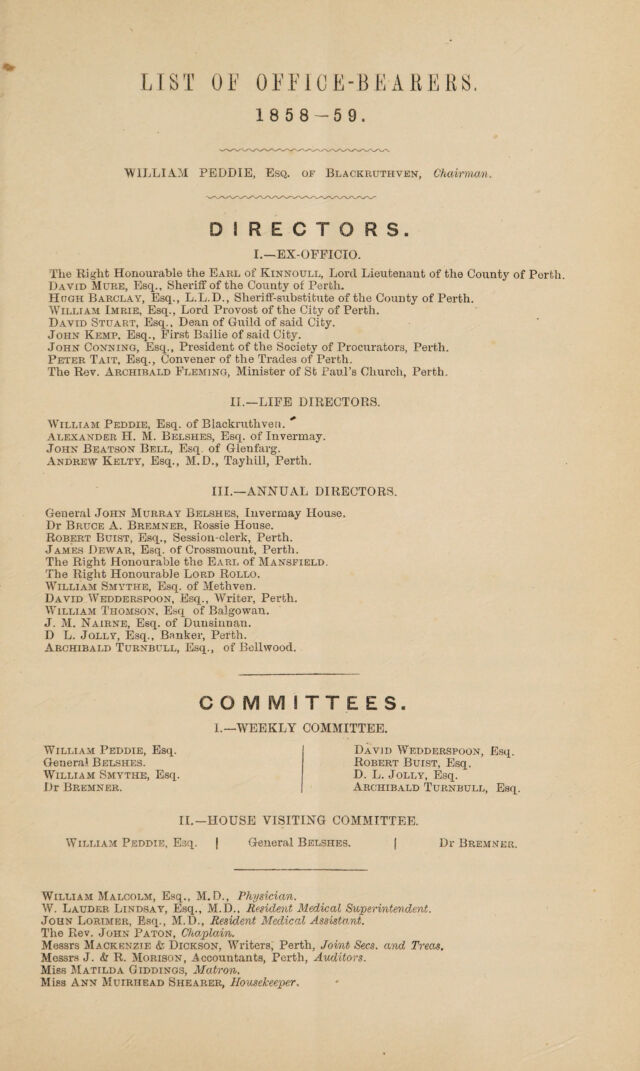
Thirty-first annual report of the directors of James Murray's Royal Asylum for Lunatics, near Perth. June 1858.
- James Murray's Royal Asylum for Lunatics
- Date:
- 1858
Licence: Public Domain Mark
Credit: Thirty-first annual report of the directors of James Murray's Royal Asylum for Lunatics, near Perth. June 1858. Source: Wellcome Collection.
12/64 page 12
![leneral ’aralysis: its (athology. ill E general -aralysis. 3 jrm 'General \ralysis ” Ssatisfac- ry. £ raedico- '^al aspects. n j. isis in jease. injected of a dark purple colour ; and there was also hypercemia of the interior of the intestines, especially the small, which were lined with a prune-juice-coloured mucus. There was a small quantity of bloody serum in the cavity of the abdomen. A fifth case was fatal by what has been denominated “serous apoplexy,” occurring in the course of Genera] Paralysis. The Dura Mater was adherent to the skull, especially behind ; the arachnoid was generally opalescent and stud¬ ded over posteriorly with numerous white granulations; and there was a large amount of sub-arachnoidean and ventricular serum. The tissues of the cerebrum and cerebellum were soft and friable; but neither was there any distinct softening nor any apoplectic clot. Three deaths fall to be recorded from General Paralysis, usually so-called. This is a term, we believe, liable to be greatly abused or misunderstood. It is too commonly and loosely used to include all cases of Paralysis occurring in the insane, or at least those associated with exaltation of ideas, or with the monomania of pride, vanity, or ambition. The name is somewhat unfortunate; for in one, and that the most characteristic, stage, the Paralysis is local and limited—partial in extent; and, moreover, ordinary and spinal paraplegia sometimes merges into Paralysis as general as this can be. Nor is it marked by a specific pathological condition; and it is not invariably associated with, nor characteristic of, particular forms of insanity. The term General Paralysis,” we believe, ought either to be more rigorously defined than at present, or it should be abolished. It has occurred to us to see many mistakes made from the too vague use of this term, which is frequently a most important one in medico¬ legal cases. In courts of law it is possible that the lawyer and the medical witness may differ as to the interpretation which they put upon these two words. The lawyer regards the “ General Paralysis of the insane” as necessarily incurable, and as necessarily implying death at a period of not more than 2 or 3 years from the origin of the disease. By using this term, then—unless the medical witness otherwise and rigorously define the sense in which he employs the word—he will be held to commit himself to this view of the prognosis—a view which his evi¬ dence may variously contradict. It has frequently been observed that in disease there is a tendency](https://iiif.wellcomecollection.org/image/b30302304_0012.jp2/full/800%2C/0/default.jpg)