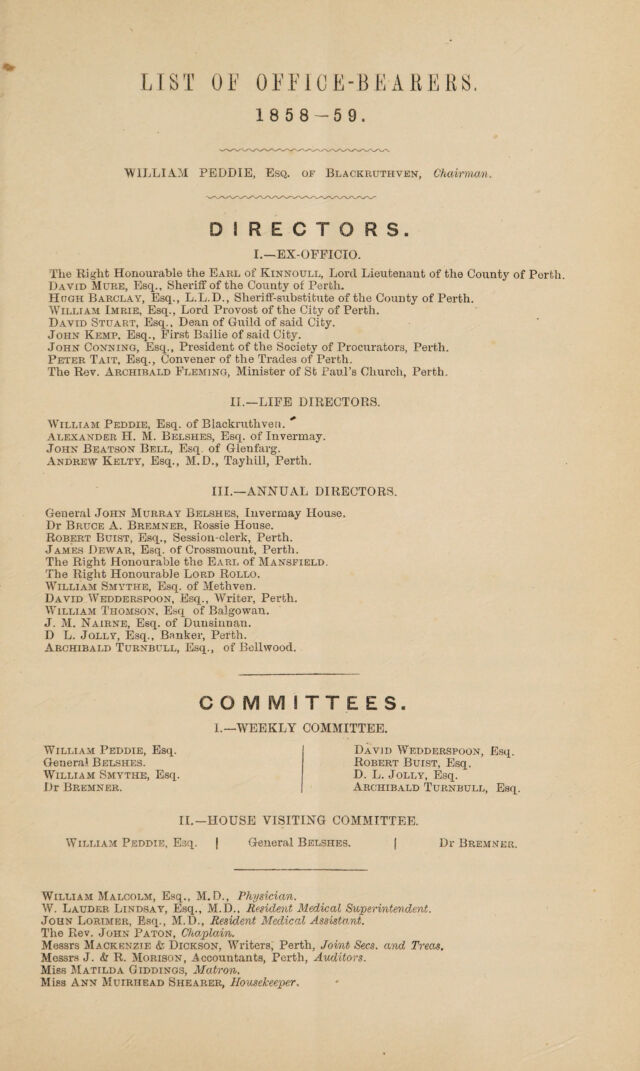
Thirty-first annual report of the directors of James Murray's Royal Asylum for Lunatics, near Perth. June 1858.
- James Murray's Royal Asylum for Lunatics
- Date:
- 1858
Licence: Public Domain Mark
Credit: Thirty-first annual report of the directors of James Murray's Royal Asylum for Lunatics, near Perth. June 1858. Source: Wellcome Collection.
28/64 page 28
![ntempe- anoe as a ause of nsanity. a: l; allaciea. ntempe- ance as an ffecfc of nsanity. 0 B l u )ipsomania nd Mania potu of recoveries among females, in the proportion of 263 to 192 males— [the numbers of the sexes admitted during the last 31 years being equal, or nearly so]. This preponderance of females in regard to recoveries holds good from year to year, and as a general rule—the disease in women being usually more acute, transient, and curable than in men. In this Asylum, Intemperance has always figured comparatively low as a cause of insanity. During the past year, of 69 admissions, intem¬ perance was assigned as the cause in only 4 cases; and in some of these it may have been wrongly so assigned. It apparently figures much higher among the recoveries, for of 22 cases discharged recovered dur¬ ing the year, intemperance was ascribed as the cause cf the original attack in 6 instances. Taking our statistics for the last 31 years, we find intemperance or dissipation to have been the assigned cause in about 10 per cent, of the total of 1130 cases admitted ; or, if we deduct the cases in which no cause is stated at all—which will leave a total of 733—in about 15 per cent. No distinction, however, is drawn— nor can it generally be drawn—between the influence of intemperance as an exciting, and as a predisposing, cause ; for, undoubtedly, in dif¬ ferent cases, it may be the one or other. Moreover, it is almost im¬ possible to ascertain in how many cases it is really the cause, or a cause, and not the effect, or an effect. For instance, intemperance is fre¬ quently associated with disappointments in business, grief, and despair, and other depressing emotions ; and it seems pretty certain that, in many of such cases, at least, intemperance and insanity are produced by the same moral causes—the intemperance exaggerating the in¬ sanity, or the insanity the intemperance. We fear that there is a great tendency in certain sections of society to exaggerate the import¬ ance of intemperance as a cause of insanity, in order to illustrate more powerfully their own peculiar views. There is no necessity for this ; the relations of intemperance to insanity are sufficiently apparent, and illustrations of the evils to which it thus leads are sufficiently nume¬ rous, to render exaggeration unnecessary and even mischievous. It may be necessary to enter a caveat against a popular error, viz., that all cases of insanity from drink are cases of Dipsomania. This term is liable to be abused and misunderstood. Cases of insanity traceable](https://iiif.wellcomecollection.org/image/b30302304_0028.jp2/full/800%2C/0/default.jpg)