Licence: Public Domain Mark
Credit: Analytical therapeutics / by C. Hering. Source: Wellcome Collection.
Provider: This material has been provided by the National Library of Medicine (U.S.), through the Medical Heritage Library. The original may be consulted at the National Library of Medicine (U.S.)
74/364
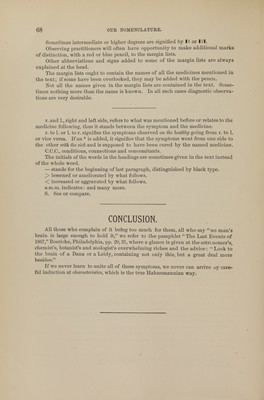
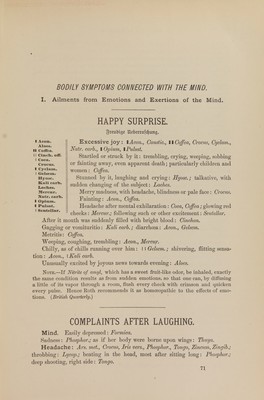
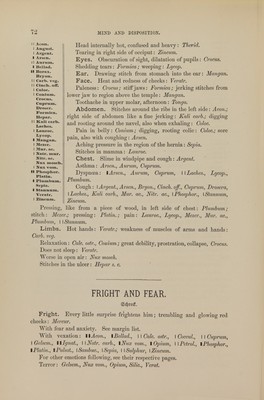
![Sometimes intermediate or higher degrees are signified by 11 or 111. Observing practitioners will often have opportunity to make additional marks of distinction, with a red or blue pencil, to the margin lists. Other abbreviations and signs added to some of the margin lists are always explained at the head. The margin lists ought to contain the names of all the medicines mentioned in the text; if some have been overlooked, they may be added with the pencil. Not all the names given in the margin lists are contained in the text. Some- times nothing more than the name is known. In all such cases diagnostic observa- tions are very desirable. r. and 1., right and left side, refers to what was mentioned before or relates to the medicine following, thus it stands between the symptom and the medicine. r. to 1. or 1. to r. signifies the symptoms observed on the healthy going from r. to 1. or vice versa. If an * is added, it signifies that the symptoms went from one side to the other with the sick and is supposed to have been cured by the named medicine. C.C.C., conditions, connections and concomitants. The initials of the words in the headings are sometimes given in the text instead of the whole word. — stands for the beginning of last paragraph, distinguished by black type. ]> lessened or ameliorated by what follows. < increased or aggravated by what follows, a.m.m. indicates: and many more. S. See or compare. CONCLUSION. All those who complain of it bei'ng too much for them, all who say no man's brain is large enough to hold it, we refer to the pamphlet The Last Events of 1867, Boericke, Philadelphia, pp. 20,21, where a glance is given at the astronomer's, chemist's, botanist's and zoologist's overwhelming riches and the advice: 'Look to the brain of a Dana or a Leidy, containing not only this, but a great deal more besides. If we never learn to unite all of these symptoms, we never can arrive uy care- ful induction at characteristics, which is the true Hahnemannian way.](https://iiif.wellcomecollection.org/image/b21128212_0074.jp2/full/800%2C/0/default.jpg)
 No text description is available for this image
 No text description is available for this image
 No text description is available for this image