Peruvian antiquities / by Mariano Edward Rivero and John James von Tschudi ; translated by Francis L. Hawks.
- Mariano Eduardo de Rivero y Ustariz
- Date:
- 1854
Licence: Public Domain Mark
Credit: Peruvian antiquities / by Mariano Edward Rivero and John James von Tschudi ; translated by Francis L. Hawks. Source: Wellcome Collection.
242/342 page 212
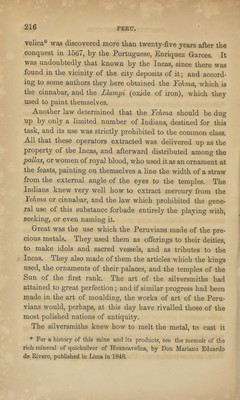
![vestigations and hypotheses upon their successive steps to perfection; while nevertheless, we indicate the progress in each one of the artistic branches. The art of working timber or manner of applying this material to common or habitual purposes, was very slightly known among the Peruvians; and it is very remarkable that they succeeded in working with more facility substances much harder, such as all kind of stones; and that although they readily invented tools to overcome their hardness, they yet could not succeed in discovering means of overcoming the fibrous tenacity of timber. They knew nothing of the saw and iron hatchet, indispensable instruments in carpentry, and with much toil they wrought out posts and beams, in limestone or marble, in place of timber. In their immense edifices, the ridge poles with their rafters only Avere of timber; they were made of the trunks of maguay {Agave Americana): the doors being of skins or linen, and even of precious metals soldered or riveted: the furniture was of stone or metal. The want of instruments adequate to cutting and smoothing the resisting fibres of the timber was the cause of the greater part of their idols being of stone ; and the small quantity of timber which has come into our possession is distinguished by its coarse and clumsy work. A part of the weapons of war were made of chonta Avood.:* Such Avere the chuqui or large lance; the titpina or pike, the onacana or species of sword, the calhua or short Turkish SAA^rd, the huicopa or small dart for throAAung, the huactana or heavy club—arms all simple, and easy of construction AV'ith their instruments of stone. It is Avorthy of note that among the clubs there AA'as one, the form of Avhich is completely identical Avith that which is used by the inhabitants of Ncav Zealand and other islands of the Pacific. Don Mariano E. De Rivero possesses * The chonta is a very hard species of palm.—[Translator.]](https://iiif.wellcomecollection.org/image/b24883463_0242.jp2/full/800%2C/0/default.jpg)

 No text description is available for this image
 No text description is available for this image
 No text description is available for this image