Peruvian antiquities / by Mariano Edward Rivero and John James von Tschudi ; translated by Francis L. Hawks.
- Mariano Eduardo de Rivero y Ustariz
- Date:
- 1854
Licence: Public Domain Mark
Credit: Peruvian antiquities / by Mariano Edward Rivero and John James von Tschudi ; translated by Francis L. Hawks. Source: Wellcome Collection.
273/342 page 243
![the image were found corpses embalmed, of the different Incas, each one seated upon his throne of gold. Communicating with this principal part there was a large apartment of polished stones, adorned at the top only with a fillet of gold, and which served as a vestibule to five chapels. The largest of them was dedicated to the moon, whose image of silver, represented with the face of a woman, was presented on one of the walls. The walls and door were covered with plates of silver: the mummies of the legitimate wives of the Incas were placed on both sides of the moon, as those of the Incas, their lords, were on both sides of the Sun. The second chapel dedicated to the stars, like that dedicated to the moon, had a door of gold; and on the ceiling of blue cloth, yellow needle-work in the form of stars. In the third chapel dedi- cated to the Yllapa, [or lightning] the walls were of gold, as in the room dedicated to the rainbow, which was painted in very brilliant colors on one of the walls. Adjoining these chapels was a chamber with the walls lined with gold, in- tended as a species of sacristy, to Huillac-Umu, and as a con- ference hall for the chief priests. Garcilasso de la Vega, speaking as an eye-witness, says (Com. Eoyal, I. Book III. Chap. XXII.): “Of these five saloons there were three only which remained in their ancient state as to walls and roof. They wanted, however, the plates of gold and silver: the other two, which were the cham- bers of the moon and the stars, were level with the ground. In the outside of the walls of those apartments which looked into the cloister there were on each side four tabernacles or niches, finished with hewn stone, as was all the rest of the house ; there were mouldings in the corners arid throughout the space of the tabernacle or niche, similar to the mouldings whence originated in Peru the ordinary proverb, when they would describe a desperate gambler : “ He gambles away the Sun before he rises.”](https://iiif.wellcomecollection.org/image/b24883463_0273.jp2/full/800%2C/0/default.jpg)
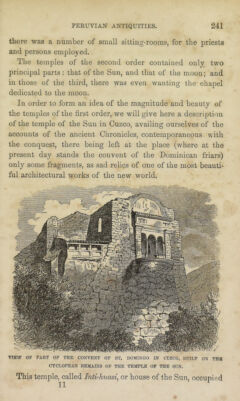

 No text description is available for this image
 No text description is available for this image
 No text description is available for this image