Peruvian antiquities / by Mariano Edward Rivero and John James von Tschudi ; translated by Francis L. Hawks.
- Mariano Eduardo de Rivero y Ustariz
- Date:
- 1854
Licence: Public Domain Mark
Credit: Peruvian antiquities / by Mariano Edward Rivero and John James von Tschudi ; translated by Francis L. Hawks. Source: Wellcome Collection.
295/342 page 265
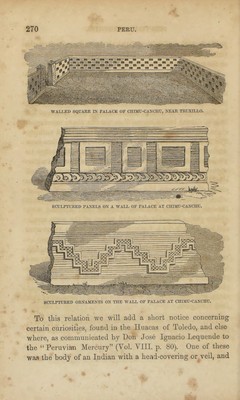
![From the village of Mansiche, which is at the gates of Truxillo, we begin to see the walls of adobe, and the vestiges of this once great settlement; and at the distance of a mile from the native village just named, on the left hand of the road from Huanchaco, commence the grand squares. The dimensions of these vary from two hundred to two hundred and seventy yards in length, and from one hundred to one hundred and sixty in breadth; their number may be seven or eight: they are found on the north side of the large edifices or palaces. The walls which surround those edifices are of considerable solidity, and are formed of adobes of ten or twelve yards long, and five or six broad in the lower part of the wall, but gradually diminishing until they termi- nate in a breadth of one yard at the top. Some of the squares contain Huacas, and the walls of large apartments or halls.* Each of the palaces was completely surrounded by an ex- * terior wall; that of the first is plain, and double the size of that of the second. It was five yards broad at the bottom, tapered gradually to one at the top, and was fifty in height. It is constructed of stone and mortar and adobes. In the first palace, which is the larger, there is another square in which are found apartments made of small stones and mortar, whitewashed within, with the thres- holds of stone from one and a half to two yards long, and more than a third of a yard in thickness: it is supposed that these were sepulchres, or perhaps apartments for the * The word Huaca, or as it is written in old Spanish, Ouaca, is Peruvian, and properly signifies any sacred place or thing; and also sometimes any thing, whether sacred or not, that is excellent or extraordinary. It was a generic term, and was applied by the natives to their idols and places of worship. It is hero applied to places of interment, large sepulchres con- taining many dead bodies.—[Translator.] 12](https://iiif.wellcomecollection.org/image/b24883463_0295.jp2/full/800%2C/0/default.jpg)

 No text description is available for this image
 No text description is available for this image
 No text description is available for this image