Peruvian antiquities / by Mariano Edward Rivero and John James von Tschudi ; translated by Francis L. Hawks.
- Mariano Eduardo de Rivero y Ustariz
- Date:
- 1854
Licence: Public Domain Mark
Credit: Peruvian antiquities / by Mariano Edward Rivero and John James von Tschudi ; translated by Francis L. Hawks. Source: Wellcome Collection.
62/342 page 32
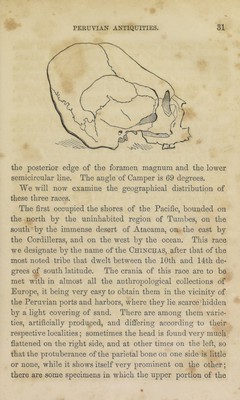
![occipital bone is so much depressed that the parietal bones protrude considerably. These irregularities were undoubt- edly produced by mechanical causes, and were considered as the distinctive marks of families; for in one Huaca* will always be found the same form of crania; while in another, near by, the forms are entirely different from those of the first. The second race inhabited the vast Peru-Bolivian eleva- tions which raise themselves twelve thousand feet above the level of the sea. M. D’Orbigny distinguishes them by the name of the Aymaraes. In this race commenced the dy- nasty of the Incas, which, in the space of a few centuries, subjected to its dominion the other tribes. The crania of these people present differences equally remarkable, according to their respective localities, and particularly in the contour of the arch of the cranium. It is proper here to remark that there is a very striking conformity between the configuration of this race and that of the Guanches, or inhabitants of the Canaries, who used also the same mode of preserving the bodies of their dead; and this resemblance is another proof which lends support to what is stated in the document or history of Yotan, be- fore referred to. The third race, concerning which we have not so much positive information, occupied the territory comprehended between the Cordilleras and the Andes, and between the degrees of 9 and 14 of south latitude.f This race, which we * A Huaca is a place of interment.—[Translator.] t These names are not unfrequently confounded. There are two great mountain ranges in Peru, running parallel to the Pacific. The nearest is at an average distance of 60 or 70 miles from the sea; the other is fur- ther inland. The western chain is what our author calls the Cordillera, and the eastern is the Andes. See Von Tschudi’s remarks on this subject,](https://iiif.wellcomecollection.org/image/b24883463_0062.jp2/full/800%2C/0/default.jpg)
 No text description is available for this image
 No text description is available for this image
 No text description is available for this image