Facts and suggestions on the registration of disease / by Benjamin W. Richardson.
- Richardson, Sir Benjamin Ward, (1828-1897)
- Date:
- 1862
Licence: Public Domain Mark
Credit: Facts and suggestions on the registration of disease / by Benjamin W. Richardson. Source: Wellcome Collection.
Provider: This material has been provided by The Royal College of Surgeons of England. The original may be consulted at The Royal College of Surgeons of England.
7/20 (page 5)
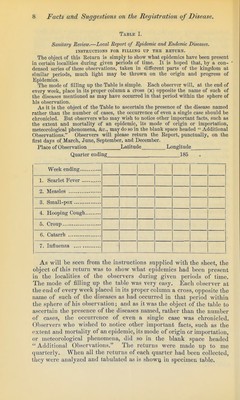
![causes and study preveution, are carried away by their own thoughts and experieuces. Possessing uo commou language, guided by no standard, working by no system, their labours are confined to their individual intellects: they leave behind no data from which otiiers may make a start, and offer no suggestive thought which their followers may work out to a solution. Nor are these the only shortcomings: there is another, having reference to the periods duriuir which the disease should be studied, of no small moment. The study of an epidemic admits of being pursued at two different times—first, when the epidemic itself is present; second, when it is absent, from the data which it has supplied. Unless this division of labour is introduced into the work, no organized system of observation will prove of avail. I believe, indeed, that half the want of success that has appeared in the study of epidemics has arisen from the fad, that by the majority of observei's these diseases are only thought worthy of consideration at such times as they are present. Hence we see, during a serious epidemic visitation, all thoughts roused and every eye observing; but no sooner has the visitation fled by, than, as if wearied outright by the duties of the task, all thought rests and every eye sleeps. I need not say to what an extent this mode of conducting an inquiry is hasty, fretful, and useless; but I would, for the sake of instituting a striking contrast and result, add this observation, that if the eclipses of the sun or moon had always been observed in the same manner as physicians observe recurring diseases, the nature of an eclipse would have remained as yet an unsolved problem. Taken simply as a natural phenomenon, an eclipse resembles an epidemic in many particulars: it comes suddenly, it conveys to the unlearned the idea of ii-regularity, it lasts only for a limited period, it rouses the fears of the common mind to the fullest extent; and amongst those who do not understand the subject in its simple, true form, every kind of vague and absurd theory is set up in reference to its causes. It is obvious, however, that the mere observance of an eclipse per se could never have explained the reason of its appear- ance, and have proved the truth of that reasoning, by the prediction of a recurrence of the same phenomenon. More was required. The facts of the phenomenon had to be taken at the time : the reason of the phenomenon had to be collected from more general observations and relationships, from after study, and from a comprehension of the order and plan of the stellar universe as a whole. In instituting this comparison between an astronomical and an epidemiological inquiry, I do not Avish to lay down an absolute paral- lelism. I know, indeed, that such docs not exist. But there is an analogy in the two studies ; and my object is to show, that the time in which an epidemic is present is not the only time when such epidemic admits of being studied ; nay, that the discovery of the laws of an epidemic visitation can only be attempted ])roperly when the epidemic is fairly past, and when the facts which it has pre- sented are fully laid out before the reasoner.](https://iiif.wellcomecollection.org/image/b22272094_0007.jp2/full/800%2C/0/default.jpg)