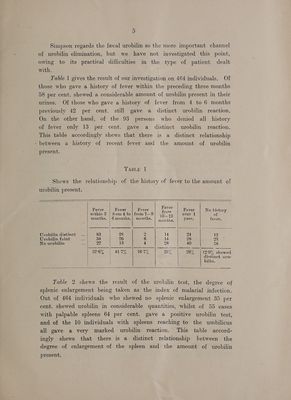
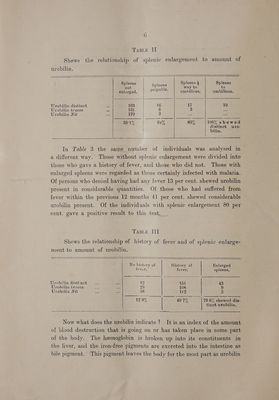
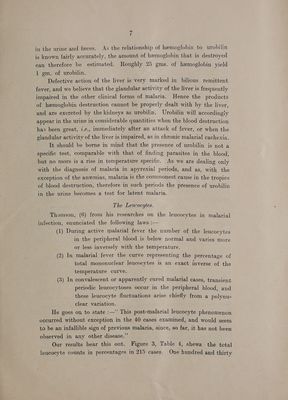
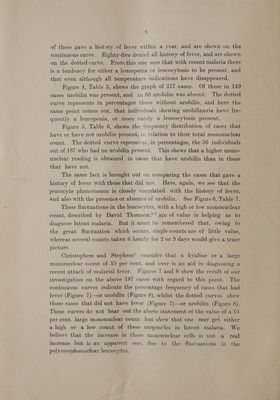
The diagnosis of latent malaria / by Hugh W. Acton and R. Knowles.
- Acton, Hugh W. (Hugh William), 1883-1935.
- Date:
- 1913]
Licence: Public Domain Mark
Credit: The diagnosis of latent malaria / by Hugh W. Acton and R. Knowles. Source: Wellcome Collection.
12/32 page 10
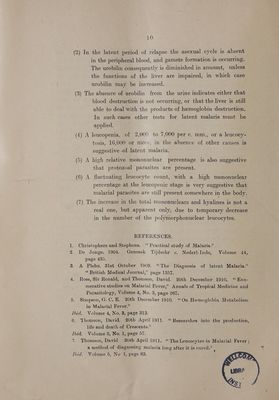
![(2) In the latent period of relapse the asexual cycle 1s absent in the peripheral blood, and gamete formation is occurring. The urobilin consequently is diminished in amount, unless the functions of the liver are impaired, in which case urobilin may be increased. (3) The absence of urobilin from the urine indicates either that blood destruction is not occurring, or that the liver is still able to deal with the products of hemoglobin destruction. In such cases other tests for latent malaria must be applied. (4) A leucopenia, of 2,000 to 7,000 per c. mm., or a leucocy- tosis, 16,000 or more, in the absence of other causes is suggestive of latent malaria. (5) A high relative mononuclear percentage is also suggestive that protozeet parasites are present. (6) A fluctuating leucocyte count, with a high mononuclear percentage at the leucopenic stage is very suggestive that malarial parasites are still present somewhere in the body. (7) The increase in the total mononuclears and hyalines is not a real one, but apparent only, due to temporary decrease in the number of the polymorphonuclear leucocytes. bo REFERENCES. . 1. Christophers and Stephens, ‘“ Practical study of Malaria.” De Jonge. 1904. Geneesk Tijdschr v, Nederl-Inde, Volume 44, page 435. 3. A Plebn. 31st October 1908. “The Diagnosis of latent Malaria.” ‘“‘ British Medical Journal,” page 1357, 4, Ross, Sir Ronald, and Thomson, David. 20th December 1910. “ Enu- merative studies on Malarial Fever,” Annals of Tropical Medicine and Parasitology, Volume 4, No. 3, page 267, 5, Simpson, G.C. E. 20th December 1910. in Malarial Fever.” Ibid. Volume 4, No. 3, page 313. . 6. Thomson, David. 20th April 1911, “ Researches into the production, life and death of Crescents.” Ibid. Volume 5, No. 1, page 57. 7. Thomson, David. 20th April 1911. “ The Leucocytes in Malarial Fever ; a method of diagnosing malaria long after it is cured.” Ibid. Volume 5, No 1], page 83. “On Hemoglobin Metabolism](https://iiif.wellcomecollection.org/image/b33435959_0012.jp2/full/800%2C/0/default.jpg)