Licence: Public Domain Mark
Credit: The psychology of alcoholism / by George B. Cutten. Source: Wellcome Collection.
85/388 page 61
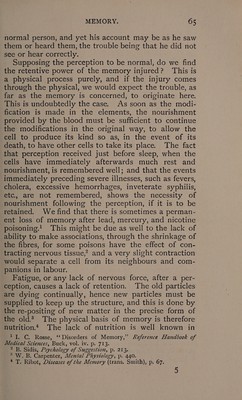
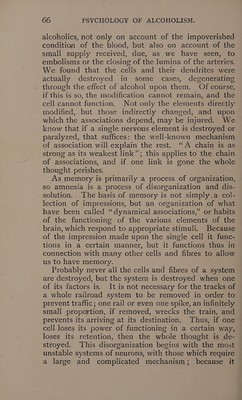
![frequently associated with illusions, and may be the result of them at times.1 The following extract shows the histological evi- dence and conclusions regarding the alcoholic’s memory :—“ Under the law of psychogenesis we had previously noted that the power of recalling past memories .. . [implies] a highly involved cortical (mental) organisation, and that it has behind it a nutritive law of deep significance. . .. This capacity depends upon the integrity ... of the cerebral organisation in two regards—viz., (a) the integrity of the latest involved and elaborated anatomico- physiological connections (or ‘fields of conjunction’) between the neurons which subserve it, and (4) the high nutritive elaboration, the high ‘nerve tension’ and capacity for spontaneous discharge of the said - neurons, from time to time.”? These two, (a) and (0), are not distinct, but will be discussed separately. In what respect does alcohol produce a change in these two above factors? In the normal relation, the dendrites and collaterals of the different cells come into contact, but in the alcoholic there is a softening and decay of the dendrites as already described; there also comes a change in the collaterals. The dendrites and collaterals form connections, not only between one neuron and another, but between one complete set and another—z.e., between nerve centres. With the dendrites and collaterals gone this connec- tion is impossible. When this happens we have a diminished capacity of the neuron to be excitable to stimuli, and a diminished permeability in the path- : ways of the nerve currents issuing from one neuron by its nervous processes and its terminals to another in the cortical area, the psychological counterpart of which would be a slowness in the arousing of asso- ciated images, and delay in reaction time. 1T,. B. Hyslop, ‘‘ Alcoholic Insanity,” 4 System of Medicine, Allbutt, vol. ix. p. 329. 2 W. L. Andriezen, ‘‘ Newer Aspects of the Pathology of Insanity,” Brain, vol. xvii. p. 673:](https://iiif.wellcomecollection.org/image/b32739552_0085.jp2/full/800%2C/0/default.jpg)
 No text description is available for this image
 No text description is available for this image
 No text description is available for this image