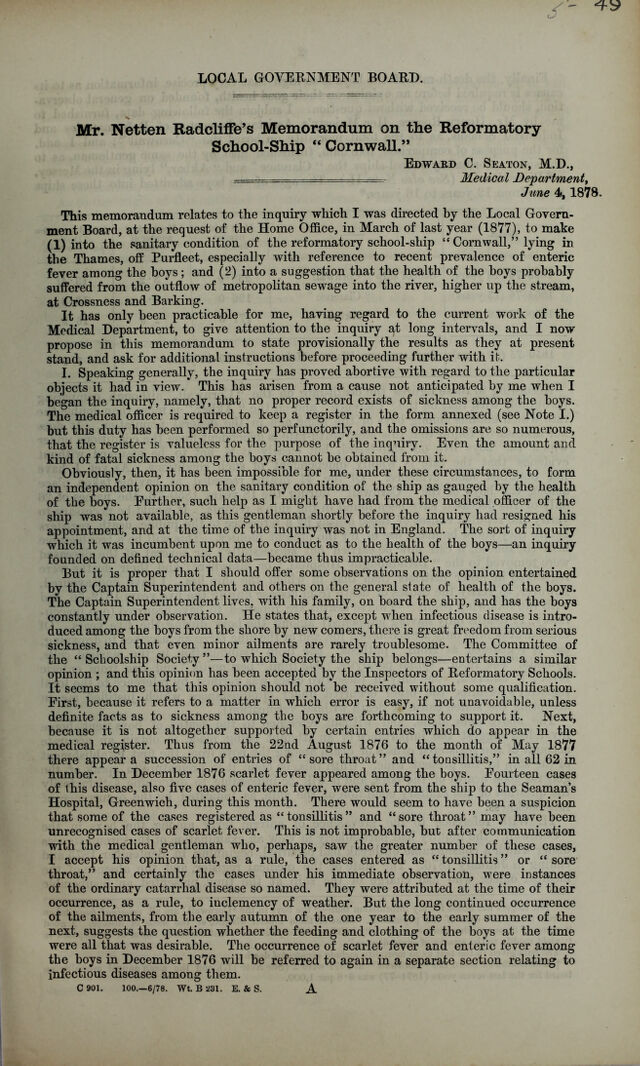
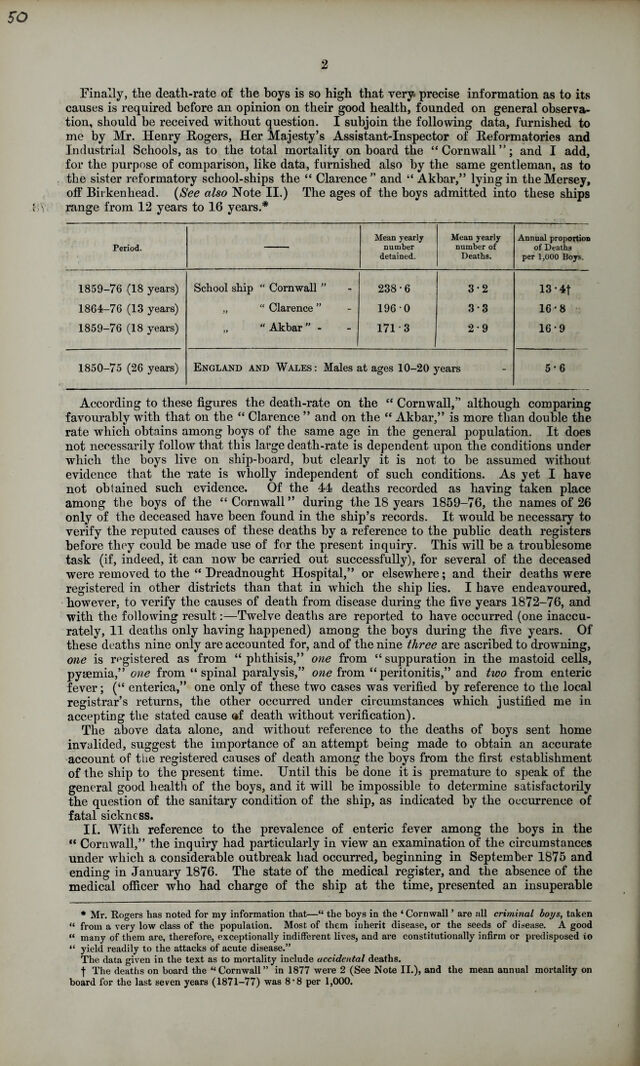
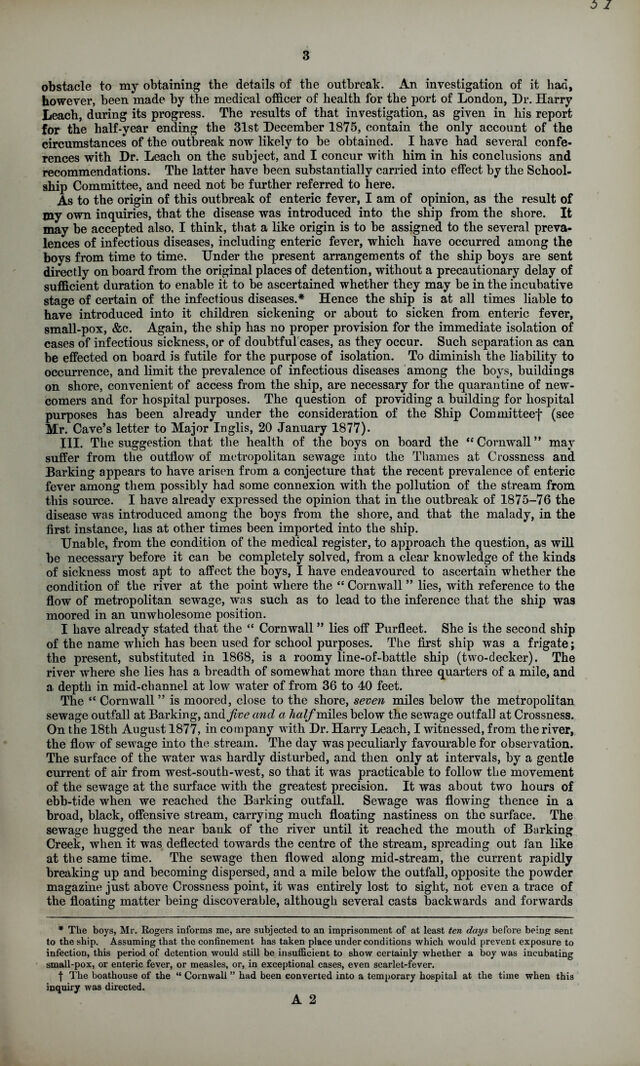
Mr. Netten Radcliffe's memorandum on the reformatory school-ship "Cornwall".
- Radcliffe, J. Netten.
- Date:
- 1878
Licence: Public Domain Mark
Credit: Mr. Netten Radcliffe's memorandum on the reformatory school-ship "Cornwall". Source: Wellcome Collection.
Provider: This material has been provided by London School of Hygiene & Tropical Medicine Library & Archives Service. The original may be consulted at London School of Hygiene & Tropical Medicine Library & Archives Service.
4/8 page 4
![4 across the river at this part of its course were made in search of it. On approaching the Crossness outfall, three quarters of a mile below the point where all trace of the sewage from the northern outfall was lost to the sight, the odour of sewage met the nostrils in advance and the southern sewage stream, carried upwards in part by an eddy, was entered a little above the outfall. The sewage had the same aspect as that from the northern outfall. It hugged the southern hank in a broad well-defined current for three quarters of a mile, then, opposite the Belvidere Guano Works, it broke up into several branches and spread out towards mid-river, and a quarter of a mile below, opposite the powder magazine there, all traces of sewage were lost to sight. On a subsequent occasion (13th Oct. 1877), with the object of ascertaining, if this were practicable, whether the bed of the river where the “ Cornwall ” is moored was affected by the metropolitan sewage outflow, I collected specimens of mud from the bed of the river in-shore, off the Barking and Crossness outfalls, from beneath the <£ Cornwall,” and from the mud exposed at low water on the contiguous bank, and from the bed of the river at Greenhithe, at a point between the <c Arethusa ” and “ Chichester ” school-ships lying there and the bank, seven miles and a half below the Crossness outfall. For the purpose of collecting these specimens, the Secretary of the Thames Conservancy Board, Captain Burstall, B.N., courteously put at my service the Conser- vancy steam-yaclit, and Captain James, the harbour-master, gave me his valuable assistance. The specimens of mud collected off the Barking and Crossness outfalls (that from Crossness being taken from several points on an exploration rod which had been sunk over ten feet into the mud-bank from which mud was collected), and from beneath the “ Cornwall ” had the appearance and odour of ordinary sewage mud. The specimen at Greenhithe had the appearance and odour of common river mud as observed anywhere within the tidal stream. These specimens were submitted to Dr. Dupr6 for chemical analysis, and he added to them for additional comparison specimens of mud taken at low water from the bank of the Thames at Yauxliall Bridge and adjoining the Houses of Parliament. I append Dr. Dupre’s report of the result of his analysis. (Note III.) It will be observed in this report that, with one exception, chemical analysis failed to show any material difference between the several examples. “ They all consisted,” to use Dr. Dupre’s words, “ chiefly of sand, clay, and chalk, and contained only a small “ proportion of organic matter. This organic matter, moreover, seemed to be very “ much of the same character in all, as shown by the slight variations in the relative “ proportion of carbon and nitrogen present in it. In fact, only one sample [No. IY. “ the sample taken from beneath the ‘ Cornwall ’] shows any material departure from “ the mean in this respect. In this the proportion of carbon to nitrogen is very te much greater than in the rest, showing the organic matter in it to be of vegetable “ origin chiefly. This is due, no doubt, to the admixture with it of an exceptionally “ large proportion of disintegrated wood. In samples I., II., and VII. [the first taken “ from the lied of the river opposite the northern outfall, the second taken from the “ mud-bank opposite the Crossness outfall, and the third from the mud-bank 50 yards “ below Vauxhall Bridge on the Surrey side] the proportion of carbon is slightly “ below the average, which may be taken as indicating a somewhat higher proportion “ of animal contamination, due, perhaps, to the presence in these samples of a larger “ proportion of sewage deposit. As before stated, however, neither the chemical nor “ the microscopic examination lends much countenance to the supposition that one “ sample consists more than another of sewage deposit.” Assuming that the small proportion of organic matter found in the several samples of mud is more or less of sewage origin—an assumption, it must be remarked, which rests rather upon the physical character of several of the samples, and generally from our knowledgeof the river, than upon the chemical analysis,—it is to be inferred either that the suspended matters of the sewage which finds its way into the Thames both above the metropolitan area towards the source of the river, and below the metropo- litan area at Barking and Crossness, are equally distributed within the section of the river selected for examination, or that each successive outflow of sewage at the Barking and Crossness outfalls undergoes so great a dilution and dispersion as practi- cally to become unrecognisable on the cessation of the flow from any deposit of suspended matter it contained. In either case sewage matter in solution may be regarded as an almost inappreciable quantity and ignored accordingly.* It is not * Messrs. Hofman and Witt in their Chemical Investigations of the influence of Sewage on the Composition of the Water in the Thames, made iu 1857, observe that“ numerous analyses by many different observers, and extending over a considerable period, have undoubtedly proved that the amount of this dissolved [organic] “ matter is exceedingly small. It has been shown, moreover, that its amount is not very perceptibly greater at](https://iiif.wellcomecollection.org/image/b24915385_0006.jp2/full/800%2C/0/default.jpg)