The best and most modern methods of the examination of urine as required in medical practice / by W. Henry Kesteven.
- Kesteven, W. Henry (William Henry)
- Date:
- 1892
Licence: Public Domain Mark
Credit: The best and most modern methods of the examination of urine as required in medical practice / by W. Henry Kesteven. Source: Wellcome Collection.
Provider: This material has been provided by The Royal College of Surgeons of England. The original may be consulted at The Royal College of Surgeons of England.
13/20 page 13
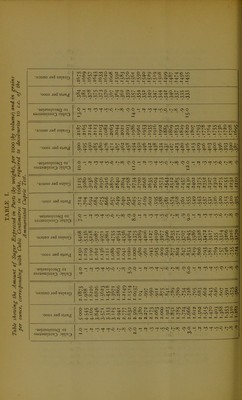
![centimetres of the test, and therefore containing 5 milli- grammes of glucose, it now only remains by a simple rule of proportion calculation to bring the expression to any form desired. There are reasons to render it advisable that the expression should be given as parts per 1 000, and it would be convenient if this plan, agreeing with what is done on the Continent, were universally adopted in this country. Suppose 4 cubic centimetres constituted the amount of diluted urine required to decolorise the contents of the flask, then—- as 4 r .005 : : 1000 : 1.250 .005 x 100 5 T „„ or or — = 1.250 4 4 To save the trouble of calculation the following table may be consulted [vide Table /]. It gives for cubic centimetres re- quired to decolorise the quantity of sugar in parts by weight per 1000 by volume. All that is necessary after the analysis has been completed is to look against the number of cubic centimetres required to decolorise, and the quality of sugar per 1000 is found expressed. It must be remembered that the quantity here expressed represents that which exists in the liquid examined. This liquid consisted not of the urine itself, but of diluted urine, and the figures must be multiplied according to the extent to which the dilution was carried. For instance, with 5 cubic centimetres of urine and water to too cubic centimetres, the figures must be multiplied by twenty; with 2.5 cubic centimetres of urine and water to 100 cubic centimetres, by forty; and in like manner for other proportions.” The table given is slightly modified from Dr. Pavy’s as the “grain per ounce” column was not given in the original table, but the column has been found useful when it has been found necessary to calculate the amount of sugar passed in any given twenty-four hours. This process requires great care in regulating the flow of the urine from the burette. If it go to fast* more than is required to destroy the blue colour will be employed ; and if too slow the liquid boiling in the flask becomes decomposed before the proper amount of urine has reached it. This is really the only drawback to this test, and it is one which practice will easily remove. Another test for sugar was described in the British Medical Journal January 5th, 1883, by Dr. Geo. Johnson. It consists in the use of picric acid and liq. potassm. For rough qualitative examination of urine, all that is](https://iiif.wellcomecollection.org/image/b22456363_0015.jp2/full/800%2C/0/default.jpg)



 No text description is available for this image
 No text description is available for this image
 No text description is available for this image