The ready reference blotter : containing desk information, calendar for three years, domestic animals: how to keep them well and treat them when ill, English dictonary, atlas, ready reckoner, address book, at 'home' days, &c / The Molassine Company Limited.
- Molassine Company Limited.
- Date:
- [1909?]
Licence: Public Domain Mark
Credit: The ready reference blotter : containing desk information, calendar for three years, domestic animals: how to keep them well and treat them when ill, English dictonary, atlas, ready reckoner, address book, at 'home' days, &c / The Molassine Company Limited. Source: Wellcome Collection.
14/102 page 10
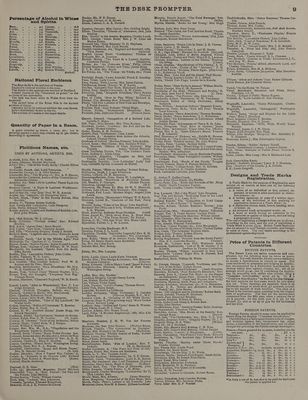
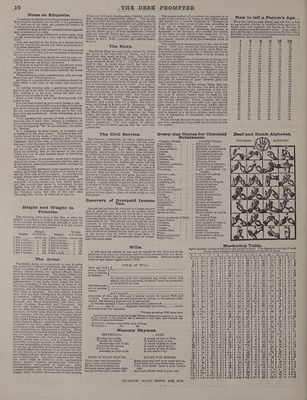
![19 Notes on Etiquette. In making an introduction the gentleman’ should be introduced to the lady, not the lady to the gentleman. If both are of the same sex, present the inferior in social position to the superior. Permission must always be obtained before a gentle. inan is presented to a lady. On gentlemen being introduced to each other, they ey. acknowledge by a bow, not by offering the and, Any one meeting at the house of a mutual friend and not introduced, should not claim acquaintance if they meet elsewhere, When out walking with a friend, if you meet or are joined bya third party, it is not necessary to introduce the one to the other. Letters of introduction should be sent by post, en- closing your own card, and not by personal delivery. This is, however, not always convenient. If anxious to honour the person introduced, invite him to dinner and have some friends to meet him. Morning calls are usually made between the hours of two and four. - When returning purely complimentary calls, you may leave your card without going in. All visits of congratulation or condolence should be fea within a few days of the event that occasions them. On making morning calls, a gentleman should not leave his hat in the hall, but take it into the room with him, holding it in his hand during his brief stay. Leave your umbrella in the hall. : » When a lady visitor leaves the drawing-room, it is ‘polite to rise, Bo. It is bad form to look at your watch during a visit. » In conversation avoid political and religious subjects, ‘and never interrupt another person while speaking. Do not converse in a language that any in the com- any does not understand, Avoid whispering, as it is tae taste. . When speaking with persons of rank, avoid the too frequent use of their titles; address a nobleman as you would any other gentleman. The Prince of Wales is only addressed as ‘‘ Sir” in conversation ; the Queen as ‘‘ Madam.” ; It is customary to write letters of invitation and acceptance in the third person. Invitations are now usually issued in the name of the lady of the house. Letters to strangers should commence with “Sir” or “ Madam,” and at the close, on the left hand corner ot the page, write the name of the individual addressed. At evening parties, put on your gloves before enter- ing the room, pay your respects to the lady of the house on entering, and do not remain to the close unless you are on very familiar terms of friendship with the hostess. 4 r Except ina case of necessity, never stop a business man in the street; if you must speak with him, walk on in his direction, state your business briefly, apologising for the detention. age In walking with gentlemen your superior in age or station, give them the place of honour by taking your- self the outer side of the pavement. In walking with a lady, always take the outer side:of the Pavement. — Wives of junior members of-a family prefix their husbands’ Christian naines—e.g. Mrs. Alfred Smith— and this socially they retain in widowhood, though legally they are Mrs. Agnes Brown, or Smith, &c. After the death of the head of a family his wife uses the Christian name, ‘the wife of the new head becoming Mrs. Smith, or whatever it may be, Height and Weight in Females. The following table gives’ a fair idea of what the relative proportions of height and weight should be in the average developed female, although it must be observed that the general tendency is to get stouter in mature and advancing years ;— 4 Weight Weight Height. in Pounds, Height. in Pounds. 5 feet, ..........about 100 5 feet 7 inches, ..about 150 5 feetrinch,.... ,, 105 § feet 8 inches, .. EEO 5 feet2inches,.. ,, x12 5 feet 9 inches,.. Ho teh} 5 feet 3inches,.. ,, 118 5 feet 10 inches, » 168 5 feet 4inches,.. 4,-» 129: ‘5 feet rz inches, 9 «TE 5 feet 5 inches,.. +,.. 137 -6 feety-sccireeees Pees: 5 feet 6inches,.. ,, 143 6 feet rinch, ..., o» 18 The Army. The British Army, as re-organised in 1904, is under the control of a Defence Committee, the members of which are aided by a staff of two naval officers, two military officers (home), two military officers (India), and Colonial representatives. The duties of this body cover the whole scheme of imperial defence. Under them, and immediately responsible for the policy and administration of the Army itself, comes the Army Council, consisting of the Secretary of State at the War Office, four military members, and two other civil members, with the Permanent Under Secretary at the War Office as secretary. The first military member deals with the Staff, Intelligence; Mobilisation, Plans of Operation, Training of all kinds, and War Regula- tions; the second, with Recruiting, Pay, Discipline, Rewards, and Peace Regulations; the third, with Supply, Clothing, Remounts, and Transport; the fourth, with Armaments and Fortifications. - One of the two other civil members (the Parliamentary Under- Secretary of State) deals with all civil business other than Finance; and the second (the Financial Secre- tary), with Finance, Audit, Accounting, and Estimates. The United Kingdom is to be divided into commands under General Officers, selected for their fitness for command in the field, called General Officers Com- manding-in-Chief, having under them Major-Generals, each commanding an Administrative District. There is also an Inspector-General (having on his Staff Inspec- tors of Cavalry, Horse and Field Artillery, Garrison Artillery, Engineers, and Ordnance and Equipment Stores), whose duty it is to form a judgment, either personally or through his staff, on efficiency of officers and men, on handling of troops, on standard and system of training, on suitability of equipment, and, generally, on all that affects the readiness of the Forces for war. He also attends, or is represented at, all manceuvres or considerable reviews of troops, and at all manceuvres acts as chief umpire, The great Commands are: first, the Army Corps at Aldershot (with headquarters there); second, Southern (headquarters Tidworth— administrative headquarters at Salisbury); third, Eastern (headquarters London); fourth, Ireland (head- quarters Dublin) ; fifth, Scotland (headquarters Edin- burgh); sixth, Northern (headquarters York); seventh, gtHh -DESE Wales and Midlands (headquarters Chester); and Lon- don, ‘forming ‘an. independent district. The revular troops provided for in 1904-5:(exclusive of 74,500 serving in India) were 227,000 ;’ estimated cost. 428,830,000, or over 20 p.c. of totalexpenditure. Austria-Hungary can put into the field nearly 3,000,000 soldiers at a cost of 475 mil. frances (17 p.c. of total. expenditure) ; France, 3.500,000 (1270 mil. francs, 35 p.c.) ;.Germany, 3,000,000 (1200 mil. francs, 21 p.c.) ; Russia, 3,000,000 (1300 mil. ee p.c.); Italy, 1,000,000 (400: million francs, 22 p.c.). The Navy. The British Fleet was practically started by Alfred the Great in his wars with the Danes, and it was developed very much by King John. The first two- decker was built in Henry VII.’s reign, and the first three-decker in Henry VIII.'s.. The ‘first frigate was built in 1630. In recent times the F. has been com- pletely revolutionised by the introduction of steam, big guns, armour, etc.; and great efforts have been made to improve it inevery way. The naval estimates have in recent years steadily risen, but, there is little grumbling over the fact, as the country recognises the absolute need of a Navy strong enough to grapple successfully with a combination of those of any other two or even three powers in the world. The ships at present number some 550 of all strengths and sizes, from great battle liners up to 18,000 tons, engines of 25,000 horse-power, and enormous gun-weight, down to the swift but frail torpedo boat. The vessels are scattered all over the world. The home stations are the Nore, Portsmouth, Plymouth, Queenstown (Ireland), and anew base for a North Sea fleet is being established at Rosyth and St. Margaret's Hope on'the Firth of Forth, west of Edinburgh. . The different squadrons are: the Channel, the Atlantic, the Mediterranean, the North American and West Indian, the Pacific, the China, the East Indian, the Australian, the Cape of Good Hope and West Coast of Africa, and the first, second, and particular service Cruiser squadrons, The total number .of officers, men, and boys is about 130,000, and the total cost 434,000,000, The Civil Service. Civil Service, collectively, all offices under govern- ment, except these directly connected :with the army and navy. In Great Britain it comprises such depart- ments as the Home Office, Foreign Office, Treasury, War Office, Admiralty, Post Office, Customs, etc. Formerly, appointments in this service were obtained by influence, but in’ 1870 it was directed they should be filled by open competition. . The salary of. clerks in the lower division begins at £80, and rises to £200, In the higher division the salaries are better, but the examinations are more severe. There are also boy clerkships for youths over 15 and under 17 years of age; and certain appointments in the telegraph service and post office are open to women, The Indian Civil Service is a branch by itself, and gives £10,000 a year and a residence to each of its three chief governors (Bengal, Bombay, Madras), and £8000 to’ Members ot Council, It gives salaries of £5000 a year and upwards to at least 27 of its officials, £4000 to 50, £3000 to 125, #2000 to 351, Fr000 to 1003. Out of these 1556, only 6r are not Europeans. There are 17,136 officials with salaries of from £100 to £1000, of whom 11,625 are not Europeans, Recovery of Overpaid Income Tax. Income tax accidentally overpaid to a larger amount than is properly due, or paid on an income which should not be charged with the tax at all, is recover- able not only for the year in whi h any such payment is actually made, but also for the two previous years— three years in all. The second case is by far the most common, as one may have an income derived from investments, etc., the total amount of which is less than £160, and yet the tax may be deducted from the sums received as interest before these are faid over; or the income may be within the larger limits of abatement (see later) and no account taken in connec tion with these sums. Wills. PROMPTER. The proper method of procedure for recovery is to apply to the Surveyor of Taxes of the district where one resides for a correct Schedule of ‘‘ Repayment Claim” suited to the nature of the case, according as it is one of exemption, abatement, or otherwise. This, filled up with all the necessary particulars, is forwarded to the Surveyor, who certifies his opinion of the claim, and the matter is then dealt with ty two of the Income Tax commissioners. These may, if they please, require proof of the statements made in the Schedule. This procedure is necessary only in the case of first claims. After that, should the circumstances remain the same, a special torm is sent which, when filled up, is forwarded to the Comptroller of Stamps and Taxes at the head Inland Revenue Office of euch division ot the United Kingdom. No claim for repayment of income tax on the grcund of title to exemption or abatement is allowed, unless it be made within three years after the end of the. year of assessment to which the claim relates. When the income does not exceed £160 total exemption may be claimed ; when it exceeds £160, but does not exceed £400, an abatement of £160 may be claimed; between #400 and £500, an abatement of £150; between £4500 and £600, an abatement of £120; between 4600 and 4700, an abatement of £70. The income of a married woman living with her husband is deemed by the Income Tax Acts to be his income [notwithstanding any settlement, or the pro- visions of the Married Women’s Property Act], and any claim in respect thereof must be made by the husband, who, in making such claiia, must include his own income therewith. Where, however, the total joint income of husband and wife does not exceed ‘500, and such total income includes profits earned both independently of each other by the exercise ot personal labour, the profit ‘so earned by the wife may be treated as a separate income, anda separate claim of exemption, or abatement, may be made in respect of it. Where the sum involved in any of the claims is con- siderable, one should always seek the aid of an Income Tax expert, Every-day Names for Chemical Chloride of formyle. Chloride of sodium, Sulphate of iron, Bi-chloride of mercury. | Sulphate of magnesia. Light carburetted .hy- drogen. Sulphate of sodium. Grape sugar. Bi-sulphide iron. Protoxide of nitrogen, Oxide of calcium, Nitrate of silver. Nitrate of potash. Sulphuric acid. Oxide of potassium, Chloroform, . Common salt, Copperas, Corrosive sublimate, Epsom salts, . 5 Fire damp, . ; Substances. Common Names, Chemical Names. Aqua fortis, . . Nitric acid. Blue vitriol, . 5 Sulphate of copper. Cream of tartar, . Bitartrate of potassium. Calomel, 4 ’ Chloride of. mercury. Chalk; 5 ‘ Carbonate of calcium, Ce ry Glauber’s salt, Glucose, . A Iron pyrites, . e Laughing gas, . Eimer. 5 . Lunar caustic, ‘ Nitrate or saltpetre, Oil of vitriol, . 5 Potash, . . Red lead, . e Oxide.of lead. Rust, iron, . . Oxide of iron. 4 Salammoniac, 5 Muriate of ammonia, Slaked lime, . 6 Hydrate of calcium, Soda, | 35 : . Oxide of sodium, Spirits of hartshorn, Ammonia. | A Spirits of salts, Hydrochloric or muria- tic acid. Stucco or plaster of Paris, Sulphate of lime. White precipitate, White vitriol, . A Ammoniated mercury, Sulphate of zine, Sugar of lead, ° 5 . Acetate of lead. Verdigris, . » + Basic acetate of copper, Vermilion, « : . « Sulphide of mercury. Vinegar, . 5 . : + Acetic acid (diluted). Volatile alkali, e . « Ammonia. Water, . . . . Oxide of hydrogen. sre How to tella Person’s Age. Show this table to your friend, and ask him or her to say in which column or columns their age is to ja found, then add together the figures at the top of these columns, and the secretis yours. Thus, suppo:s, 21 to be the age ; this number occurs in the first, thir, and fifth columns ; add the top figures of the three, and we.have 21, the number required. : 1 2 4 3S S16) 32 ; 3 3 5 9 17 33 5 6 6 10 18 34 7 7 7 Ir 19 35i 9 10 12 12 20 36 II Ir 13 13 21 37 13 14 14 14 22 38 15 15 15 15 23 39 17 18 20 24 2 40 19 19 er 25 25 4I 2I 22 22 26 26 42 23 23 23 27 27 43 25 26 28 23 28 44 27 27 29 29 29 45 29 30 30 go 30 46 3 3t 3t 3r 3r 47 33 34 36 40 48 48 35 35 37 4r 49 49 37 38 38 42 50 50 39 39 39 43 5 5t 41 42 44 44 52 s2 43 43 45 45 53 53 45 46 46 46 54 54 47 - 47 47 47 55 55 49 50 52 58 56 56 st 5I 53 57 £7 57. 53 54 54 58 58 8 55% 55 55 59 59 pe) 57 58 60 60 60 60 59 59 6r 6r 6r 65 6r 62 62 62 62 62 63 63 63 63 63 63 94* Tn the first column is the pri ce per poundor yard, The figures at the top of each A will must be written in ink, and be signed by the Testator, in the presence of at least two witnesses, and if written on more than one sheet, I 2 3 4 5 6 van 8 9 EC) II 12 | z- each sheet should be signed by testator and witnesses. Persons under 21 alsoals. dla dis:d.|s. da|s aisdjis. djs. dls. d.|/s. ald years of age cannot legally make a Will. . 4 4 ok | 0 oF |0 r]o xf] 0 rdlo Bl 0 2] 0 Ai © 24}0 2% ]0 3 o.r |}o rjo 2}0 ZI °,.3]0 34/0 4/0 45/0 5]|-0 it °o 6 ‘ FORM OF WILL. 4 o If] 0 es! 0 3|0°32]/0 44]/0 54] 0 6/0 6%10 740 BE ]0 9 Hereenut sfaill 1 Sesnpecowcvedecdsdebucvecce EP OLse Oe gi [Orsi OS [Ol TON FO! Fu cOMGLO WONINO: 2014/0. TE Nex) OMe name, occwpa- greet acess eee ereteseeeeesceeeers ih | o- 2klo. 28|o.10 S| 0 74) 0 88] 0 x0] o x14) x off x a 2 3 4 tion, & address ee we eeeee oe eee eeweeenee I ° 3 ° 44 o 510 7% © 9| 0 ros] © oO] © a LPS ey ras |e I of Testator. lefelsisio aie steleielereis siaipteie nls alse acncecsieehece Reesvoesessacceees 13] 0 34|0 5$]|:0 i o 83] 0 z04| x of] r 2/2 rt 5s) r 74} 2°91) 18 do hereby give and bequeath my whole estate and ai lho. 4 |0,096|.0 oso |x olz 2/31 4x 6|x 8{/xrz0o |2 0 3 effects, real and personal, of which I may die possessed, 2t|o 44|0 6810 9|oxth]'t 14] 5 r 6] x 84}. 1 104] 2 2 3 3 or be entitled to, unto 2kh}/0 5 |o 74] 010/12 3 I 3] 5s x 8] x 104] 2 az 2 3 2 bs FT ONC ANSEL DEP Veipse viaiaieivib sit aloloie's,s\sjaiels sieve d's asleleSiagisie e's(o\e .e(e sieisjeieieisteselsisie si0(8 2azlo sslo 8$]/axr| xr rf r- 44] x 74] 4 10] 2 oF 2 33) 2 29 son or persons’ } iad 3 [0,6 |.059 }reoi.z 30) 2.64 tao lf2< Ola, sia 3 2.9.5), 3 Omnis names, Te aw pene 6 34|0 64]0 of] x x| x 4f|.2 7h] x 108] 2 2] 2 54) 2 84] 2 1x3 | 3 3} 3 and I appoint.... 3h |}0 7 | oroh| x 2] Se|t 9} 2 1 2 4/2 74/211 | 3 24/3 : executors of this, my Will, and I hereby revoke all for 33. | 0 7h] o x14] 2 3] x Of] 1 x04] 2 24] 2 6) 2 OF] 3 I4/3 5 3. O03, Codicils. I also ordain my said executors to deliver to the persons after- 4 |o 8 Lzco |x 4)2+8 [2 ©} 2 4) .9>81 3.013 4 3 4 0/4 named, the following legacies out of said estate. at |o 8b] x r 5|x of] 2-14} 2 53] 210] 3 24/3 64] 3 10% | 4 344 In witness whereot I have subscribed these presents at ....+++ 44|}0 9 | Ie] Xr 6] rI1oZ/ 2 3/2 ii 3 913 42/3 9/4 I) 4 é this..........day of..........Eighteen Hundred and Ninety... o of| x 2f| x 7| x x18] 2 44] 2 of) 3.2] 3 O#| 3 11d) 4 4d | 4 3 in presence of two witnesses, 5 jor |r 3/2 8j}2r dl 6\2 38 3 e 3 Be ‘ ri ? 7 : 3 5 * Person granting Will signs here a See 7 ae 5 Ai > a a 2a gl 4 4 47/5 s# 5 6 3 Signed by the Testator as and for his last Will and Testament in presence of us, who, Io 3415 9 52 at his meteat in his presence, and in presence of each other, neve hereunto sub- 3 Oat : Pu z eS : o ‘ = : Zi i ° : 2 ; 2 3 6 |6 of 6 scribed our names as witnesses 64 : ot x 6 3 r}]2 74}.3 1413 73) 4 214 84/5 2615 8216 31] 6 WITNESS—Name, orcupation, and address. 64 |x 1 I 7|22)2 u 30313 er 4 414 1 5 515 a 6 6 ( WITNESS— Do. de, 62|x rm|x 8|2 3/2 98/3 4 3 31 ‘ . 5 : 5 2 A 3 : 3 ; ; m2 |x 2 4/235 |'3 4 1 Memory Rhymes. Desay labes tates 3 7H] 4 23] 470) 5 54/6 ofS 78/7 3) 7 BIeTED ats - BEES. gee te Ae seals a cried Monday for health, A swarm of bees in May, 4 - ak a 1 os 2 A ol4 &ls 416 0/6 8/7 4/8 0/8 Tuesday for wealth, Is worth a load of hay ; attr 4h12 0 = 913 st] 4 x4] 4 9815 6] 6 24] 6 rod] 7 68) 8 3 ai Wednesday best of all; A swarm of bees in June, shir 5 |2 rk) 21013 6414.3 | 42415 8/6 4417 117 9 8 6/8 Thursday for crosses, Is worth a silver spoon ; e3|x ch|2 of} art] 3 72] 4 44] 5 14] 5 10] 6 O62] 7 34] 8 of | 8 9 | 82 Friday for losses, A swarm of bees in July, 9 |x 6123.13 013 9) 4 615.316 6 917 6 8 3 19 o}9 Saturday no luck at all, Is not worth a fly. ot |x 6k] 2 32] 3 | 3 x0f| 4 74] 5 43] 6 2] 6 234] 7 84] 8 9 3/9 4 17 |2 4513 2 sig 4 3 g aS a7 yan See 9 6 DAYS IN EACH MONTH, RULES FOR RIDING. oz} x 7412 3 3] 4 o8| 4 104) 5 84/6 6/7 3 14 949 i a ro |r 8/2613 4/4 2/5 0] 5210/6 87 6/8 4]9 2. |10 O]10 Thirty days hath September, - Keep your head and your heart well up, Sie sale Gee Bly 3 x4] 5 113] 6 x0] 7 84/8 64! 9 42 |t0 3 |r0. April, June, and November, Your hands and your heels keep down, FB 6] 4 ab|5 316 xh 7 of 7 x01 8 9] 9 74 |t0 6 |10 Al the rest have thirty-one, Press your knees close to your horse’s 3 a S ‘A 3 ala: silgsalls 7 2/8 of| 8 x14] 9 4 10 9 {104 February alone hath twenty-eight, side, ee = es ae 4 8147/8 616 S17 418 3]9 2 \10 x rx 0 [rx Except in leap-year, twenty-nine, And your elbows close to your own. aT rxoh|2 9313 9]4 8t| 5 7] 6 : 7 ° : 54] 9 44/10 3 1x 3 m4] r11r | 2 Io 1o| 4 94/5 9|6 83/7 7419 7 |10 Ir 4 rihla2 of irl 4 Ee 5 104] 6 rog| 7 20] 8 i 9 9hlt0 94 [tx g I38 e..8](https://iiif.wellcomecollection.org/image/b33446258_0014.jp2/full/800%2C/0/default.jpg)