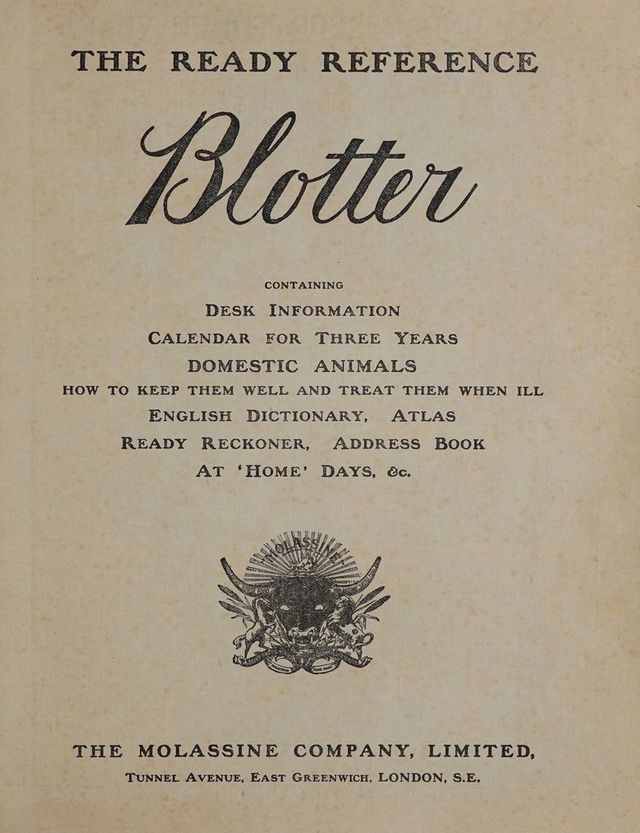
The ready reference blotter : containing desk information, calendar for three years, domestic animals: how to keep them well and treat them when ill, English dictonary, atlas, ready reckoner, address book, at 'home' days, &c / The Molassine Company Limited.
- Molassine Company Limited.
- Date:
- [1909?]
Licence: Public Domain Mark
Credit: The ready reference blotter : containing desk information, calendar for three years, domestic animals: how to keep them well and treat them when ill, English dictonary, atlas, ready reckoner, address book, at 'home' days, &c / The Molassine Company Limited. Source: Wellcome Collection.
9/102 page 5
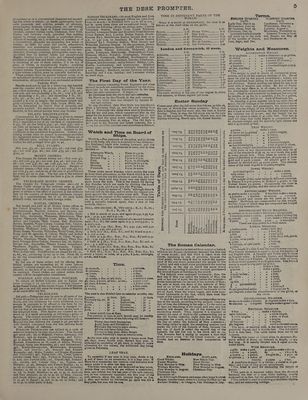
![of courtesy or ot a conventional character not exceed- ing five words or initials ; (2) deeds, agreements, insur- ance proposals and policies, powers of attorney, proxy papers, licences, voting papers, etc. (all writing forming part of the legal or formal instrument); (3) circulars, printed visiting cards, Christmas, New Year, Easter, and birthday cards, provided that nothing eee | in writing except details or particulars (dates, objects of meeting, edi or formulas of courtesy or of a conventional character not exceeding five words or initials; (4) MSS. for press and proofs, educational exercises, and examination papers, with comments, corrections, and instructions. There may also be sent : sketches, drawings, paintings, photographs, maps, etc., provided they be neither brittle nor exceptionally fragile ; blotting books and pads, and coloured papers attached to price lists and trade circulars, the binding or mounting of any of these articles, if it be not of glass, or brittle, or exceptionally fragile; anything necessary or convenient for the safe transmission of any of these articles. Type-written circulars, or copies from a type-written original, must be specially handed in. These packets must be posted without cover, or in an unfastened envelope, or in a cover that permits easy examination, All packets over 2 oz. are treated as letters - PARCEL POST. Parcels must not be put in a letter-box, but handed over the counter with the stamps affixed. The rates are :—Not exceeding 1 Ib., 3d.; 21b., 4d.; 3 1b., 5d. ; over 3 lb. and not exceeding 5 lb., 6d.; over 5 lb. and not exceeding 7 lb., 7d.; not exceeding 8 lb., 8d.; 9lb., 9d.; 10 lb., rod.; 11 Ib., rrd. No parcel must exceed 3 ft. 6in. in length: the maximum length and girth combined, 6 ft. Glass, Fish, Game, Meat, etc., can be forwarded by Parcel Post if properly and securely packed. No explosive substance, liquid ina bladder, or live animal (except bees) may be sent. INLAND REGISTRATION. Compensation for loss or damage is given in respect of Inland Registered Packets of all kinds as follows :— For a registration fee of 2d. the limit of compensation is £5; for 3d. the limit is £20; 4d., limit £440; and so on, with an increase of #20 for each 1d. additional up to £400, for which the fee is 1s. rod. Subject to the conditions in the published Regulations, Letters con- taining money must be posted in envelopes provided for registered letters by the Post Office. These are of five different sizes, varying in price (inclusive of regis- tration fee and postage) from 34d. to 4d, BILL STAMPS. Not over £5, 1d.; not over £10, 2d. ; not over £25, 3d.; not over £50, 6d.; not over £75, 9d.; not over 4100, 1S, MONEY ORDERS. The charges for Inland Orders are :—Not over £1, 2d.; not over £3, 3d.; not over £10, 4d.; not over £20, 6d. ; not over £30, 8d.; not over £40, rod. No order may contain a fractional part of a penny. Foreign or Colonial Orders :—Not over £1, 3d.; not over £2, 6d.; not over £4. 9d.; and so on at the rate of 3d.additional for every £2 up to £40. The last sum is the extreme limit, but in some countries the limit is £10, in others #20. TELEGRAPH MONEY ORDERS, The charges for Telegraph Orders are:—(1) A Money Order charge at the ordinary rates as given above for home and abroad ; (2) a charge for the tele- gram of advice to the office of payment at the ordinary rate for the country of destination (minimum charge, 6d.); (3) a supplementary fee of 2d. for each home (Inland) order, and 6d, for each foreign order. POSTAL ORDERS Are issued and paid at all Money Order offices in the United Kingdom, at the British Post Offices at Constantinople, Beyrout, Salonica, and Smyrna, the British postal agency at Panama, and in Aden, Anda- man Isds., Ascension, *Bahamas, Baluchistan, *Bar- badoes *Bermuda, *British Cent, Africa, *British E. Africa and Uganda, *Brit. Guiana, Brit. Honduras, Burma, Bushire, *Cape Colony, Cayman Isds., Ceylon, ‘Chatham Isds., Cook Isds., Cyprus, Egypt (including Soudan), *Falkland Isds., Fanning Isd., Federated Malay States, *Gambia, *Gibraltar, *Gold Coast, Hong Kong (and its agencies in China), *India and Indian post offices on Persian Gulf and in Tibet, *Lagos, *Malta, Mauritius, *Natal, Newfoundland, *New Zea- land, *Orange River Colony, Penrhyn Isd., St. Helena, Savage Isd., Seychelles, *Sierra Leone, Somaliland, *Southern Nigeria, Straits Settlements, Tangier, *Transvaal, *Zanzibar, and the *principal British West Indian Isds. Postal’Orders are issued for 6d., 1s., 1s. 6d., etc., advancing by 6d. up to 21s. From 6d. to 2s, 6d. the commission is 4d. ; 3s. to 15s., 1d.3 158, 6d. to 21s., 14d. By the use of these orders and by affixing three British stamps not exceeding 5d. in value (places marked * colonial stamps also, fractions of a penny not allowed) to the face of an order, any odd amount may be remitted. Postal Orders not cashed within three months will be charged extra commission. FOREIGN AND COLONIAL POSTAGE, To almost all British Colonies and to Egypt the letter postage is 1d. per half oz.; to foreign countrie’ in the Postal Union, in the course of 1907, it will become re per x oz. and r4d. extra for every ounce or fraction of an ounce after the first. TELEGRAMS. INLAND.—Telegrams may be sent to all parts of the THE DESK SUNDAY TELEGRAMS,—In most English and Irish provincial towns the Telegraph Offices are open from 8 a.m. to 10 a.m. ; in Scotland, from 9 a.m, till ro a.m. 5 but in some cases there are exceptional hours. In London the following offices are always open : Central Telegraph Station, King’s Cross (Great Northern Station), Liverpool Street and Stratford Street Stations (Great Eastern Ry.), London Bridge Station (South- Eastern Ry.), Marylebone Station (except from 11.30 a.m. to 3.30 p.m. on Sundays), St. Pancras Station (Midland ey, Waterloo Station, West Strand, and Willesden Junction Station. In the provinces, always open are: Birmingham, Bristol, Cardiff, Derby, Devon- port, Dover, Exeter, Falmouth; Holyhead, Hull, Leeds, Liverpool, Manchester, Newcastle-on-Tyne, Newport (Mon.), Norwich, Nottingham, Penzance, Plymouth, Portsmouth, Sheffield, Southampton and Swansea; in Scotland: Aberdeen, Dundee, Edinburgh, Glasgow, and Inverness; andin Ireland: Belfast, Cork, Dublin, Londonderry, and Queenstown. Brighton always open except between midnight Saturday and a.m. Sunday; Bradford, except between midnight Gorerdey and 8 a.m, Sunday; and Leicester always on week days, The First Day of the Year. Many persons consulting Parish Registers and other ancient records are sometimes perplexed by the dates, especially by the seeming discrepancies in the time when the yearcommenced. It began:— At Christmas from the 7th to the 14th centuries, On March 2s, by the Church, in the reth century, and the same date was adopted by laymen in the 14th century. In 1752 (Scotland, 1600) New Style was introduced, Sept. 3 becoming Sept. 14, and the year dating from Jan. x. Previously two dates were used in documents, one for the civil year, which commenced Mar. 25, the other for the historical year, which Ug jepet boc 1; and thus we find the same event chronicled under the dates, for example, Feb. 26, 1683-4. The Old Style is stil used in the Russian and Greek calendar, Fans I Using jan. 13 of the calendar used elsewhere in Europe, Watch and Time on Board of Ships. WATCH.—For purposes of discipline, and to divide the work fairly, the crew is mustered in two divisions: the Starboard (right side, looking forward), and the Port (left), The day commences at noon, and is thus divided ;— Afternoon Watch, e Noon to 4 p.m, First Dog i ne ° 4p.m to 6 p.m. Second Dog ,, . . 6 p.m to 8 p.m. First iis ° 8 p.m. to midnight, Middle eet . midnight to 4 a.m, Morning oo 2 «© arm, to.8 a.m; Forenoon AW eit) 5 8 a.m. to noon, These make seven Watches, which enable the crew to keep them alternately, as the Watch which is on the forenoon one day has the afternoon next day, and the men who have only four hours’ rest one night have eight hours the next. This is the reason for having Dog Watches, which are made by dividing the hours between 4 p.m. and 8 p.m, into two Watches. TIME is kept by means of ‘‘ Bells,” although there is but one bell on the ship, and to strike the cla per pros perly against the bell requires some skill. First, two strokes of the clapper at the interval of a second, then an interval of two seconds; then two more strokes with a second’s interval apart, then a rest of two seconds, thus :— BELL, ONE SECOND; B., TWO SECS.; B.,S.; B.,SS.3 BigiSes) Bigiso, } Be r Pell is struck at 12.30, and again at 4.30, 6.30, 8.30 Pp-M. ; 12.30, 4.30, and 8.30 a.m. 2 Bells at x (struck at an interval of a second between each—B.s., B.), the same again at 5, 7,andgp.m.; 3, 5, and 9 a.m. 3 Bells at 1.30 (B.s., B.ss., B.), 5.30, 7.30, and 9.30 p.m. ; 1.30, 5.30. and 9.30 a.m, 4 Bells at 2 (B.s., B.ss., B.s., and B,) 6 and 10 p.m. ; 2, 6, and 10 a.m. 5 Bells at 2.30 (B.s., B.ss., B.s., B.ss., B.) and 10.30 p.m. ; 2.30, 6.30, and 10,30 a.m. 6 Bells at 3 (B.s., B.ss., B.s., B.ss., B.s., B.) and rz Pp.m.; 3, 7, and 11 a.m, 7 Bells at 3.30 (B.s., B.ss., B.s.,B.ss., B.s., B-ss., B.) at 11.30 p.m. ; 3.30, 7.30, and 11.30 a.m, 8 Bells (B.s., B.ss., B.s., B.ss., B.s., B.ss., B.s., B.) every 4 hours, at noon, at.4 p.m., 8 p,m., midnight, 4a.m., and 8 a.m. Time. Go'seconds, se fe I minute, 60 minutes, . . . ° . x hour. 24hours, . ° t5 5 . 1 day. 7 days, co ° . 1 week, 1 ordinary year, 1 solar year. 1 Julian year. » xleap year. « X quarter, 52 weeks, 1 day, or 365 days, . 365 days, 5 hours, 48 min., 43 sec., 365 days, 6 hours, . 5 ; - 366 days, “5 13 weeks, e . . . . . . . e ° ° The year is also divided into r2 calendar months, viz.: United Kingdom at the rate of 6d. for the first twelve impenlecs (29, or), oe days. Ve 2 : oa days, words, and one halfpenny for every additional word; March, Span 3I v2 Seprember ° : Ee ” stamps in payment to be affixed to the form by the April, 5 > Fo * Otteher’® - . ae ” sender. The address of the receiver is charged for. May, . : ne ” Naveialer : . A ” but not that of the sender when written on the back of June, . i + 30 ly Decenibers e a 4 tthe telegraph form, Five figures are counted as one ‘word, so is a letter preceding or following a group of ‘figures. The charge includes delivery within the tewn ypostal limits, or within three miles of the terminal office, Beyond the free delivery the charge is 3d. per mile or part thereof, calculated from the free delivery linits to the address of delivery. FOREIGN TELEGRAMS are subject to a code of rules too lengthy to be here reproduced. The charges word are: 2d..to Belgium, France, Germany, and olland; 24d, to Algeria, Luxemburg, and Tunis; d. to Austria, Denmark, Gibraltar, Hungary, Italy, panish Possessions on N.coast of Africa, Norway, Portugal, Spain (via Marseilles, 5d.), and Switzerland ; 4d., Bosnia-Herzegovina, Montenegro, Roumania, etek, and Sweden; 4d., Bulgaria and Eastern Roumelia ; 44d., Malta, Tangier. and Russia (European and Caucasus); 54d., Faroe Isds, ; 6d., Crete, Greece, and the Greek Isds.; 64d., Turkey in Europe, Turkey iin Asia, and Turkish Isds.; 7d., Tripoli; 84d., Iceland ; od., Azores, and Canary Isds.; 1s., Cyprus, and Madeira; 1s. 5d., Senegal, and French Soudan; 1s. to 3s. 2d. to Canada; ts. to 2s. 9d. to the U.S. (including Alaska); 1s. 8d. to 7s. 5d. to the West Indies; 3s. to 7s- 7d. to South America; 2s. 9d. to 3s. to Australia and New Zealand; 2s, 1d. to 3s. 1d. to East, Central, and South Africa; 3s. 6d. to 11s. to West Africa; 1s, to 1s. 4d. to Egypt; 1s. rod. to 2s. 1d. to India; and 4s. to 5s. to other parts of Asia. A lunar month has 28 days. . The number of days in each month may be readily remembered by means of the following old lines :— Thirty days hath September, April, June, and Noweaber ; ebruary has twenty-eight alone; All the rest have thirty-one, Except in leap year, when design Gives February's days as twenty-nine. As the true solar year is nearly 6 hours more than 365 days, every fourth year, termed leap year, is reckoned as consisting of 366 days, in order to make allowance for the excess, the additional day being given to February, ; LEAP YEAR. To ascertain if any year is leap year, divide it b 4, and if there be no remainder, it is a leap year; if there be a remainder, the number over indicates how many years it is after last leap year, The even centuries are not reckoned as leap years, unless they can divide by 400 without a remainder; thus, 1900 (which was the last year of the roth century, not, as was commonly supposed, the first year of the zoth century, since the i9th century began on Jam x, 180r, and ended on December 31, 1900) was not a leap year, but 2coo will be one, PROMPTER. TIME IN DIFFERENT PARTS OF THE WORLD. When it is NOON at GREENWICH, the time is as follows at the chief cities on the globe: A.M. A.M, Boston, .cccscesserees 7-18 Monte Vicleo,...5..++ 8.17 Chicago,....qescseeses 6.8 New York,..scoceeees Jed Dublin,....csesceseee+¥.35 Philadelphia, .......6+ 6.59 Edinburgh 210.47 Quebec, ....seeeeeeee J-15 Lisbon, +-11.43 Rio de Janeiro,...... 9.8 Madrid,... eoeeTI.45 San Francisco,.....0+ 3-49 London and Greenwich, 12 noon. P.M. P.M. Adelaide, ......+.++++ 9:14 MOSCOWysesersererere 2:30 Aden,.....sseeeeeee++ 3-0 Munich, ...00- ees 0.46 Amsterdam, ......+++ 0.20 Paris, ssseseeee + 0.9 Berlin,.. eoee 0.54 Pekin, .... 7.46 Berne,... «ee. 0.30 Rangoon 6.24 Bombay, . soceee 4.52 Rome,.... 0.50 Brisbane,. eeees10.12 Rotterdam, . see 0.10: Brussels, ....sesee++- 0.17 St. Petersburg,...... 2.0 Calcutta, ... oe 554 SUCZ,cecsceecevees I Cape Town, ......... 1-14 Sydney, ...+.0+6 Constantinople, ...... 1.56 Stockholm, ..... -. 0.50 Stuttgardt,... +. 5.21 Vienna, ..... - 058 Wellington, .....++...11.40 Melbourne, ........++ 9.40 . The earth revolves at the rate of one degree in every four minutes, or fifteen degree* per hour, Easter Sunday Comes next after the full moon that follows, or falls on, the 21st of March (the vernal equinox). When that date is Sunday and full moon also, the next is Easter Sunday. Thus, in 18094, the full moon was on the very day of the equinox, Wednesday, March arst, and the Sunday following, March 25th, was Easter Sunday. STK tst MM ial @ | recor | SSSFRSRRSS SY | ¢ fo} c 5 TMM tM YW INI cre iS AON OL Bedanwn Pa | x o o a <. a el ute = | voor | S32eBEasagag | § S E fs ma st ma gy wt ©; | ydago, SASBPGSaease 3 > % QakHwH mANS = 2 aq wtsrnn BE | Seven | GREs eo Wekewe | 3 ° bo) a3 : E es. | -fnfo BHI A6HEMSRIA uv r) ZZ me MMNMAN A a BS Q 3 % <a « n Ll bs Heep lio) 2) reeateaks Azz | omfor | RRoe MAREN TAR | g C Oe ZA SSe Ons ees La one) * a DO MONTH OM os OFA ACW OL RPO MR RARaA ane is yg 2 Bol nay op) Badoes eoea wees oy x2) lev OL MAMAN AHHH 7 Oo B52 | wor | S8EREeeeuea | 3 Bg PW OL OO NOMAANKeA 3 i a) Geile oe |enten eee cea Silla Bia MeAAN AHA 3 =) 3 beef u “4 w womnnst ise] ish celetrace |\N BGR POG ee GARG) ie hice w ANMAA NHR =} : ty ay & . Aerio ro. co re iY) : sittin sGer cee celal ‘3 3. 40) ia) ceahge teense tie’ o 5 g Sanccht Soe sGs\O gi gin | by Parivane) emstee skisiaies a a . a bsd2:.: 352388 | 8 3 Sos sg 2228509 2 n HOR RS oS Mae eS a o S5s500 7 Snedes55<4n0ZzQ |™ The Roman Calendar. The word Calendar is derived from calend or kalend, which in the Roman chronology denoted the first day of every month; and this word is taken from the Greek, signifying to call, or proclaim, because the chief priest, whose duty it was to watch the appear- ance of the new moon, summoned the people to the Capitol, and with a loud voice proclaimed the number of kalends, or the day on which the moves would happen, or, according to another account, proclaimed the several feasts or holidays in the month. The kalends were reckoned backwards; thus, the first bad | of May was called the kalends of May, the 3oth or last day of April, the day before the kalends— pridie kalendarum—or second of the kalends of May; the 29th of April, the third of the kalends of May, and so on to the 13th of April, when the ides com- menced, which were also reckoned backwards to the p> of April, when the nones began, and were num- ered backwards to the first, which then took the name of the kalends of April. To find the day of the kalends corresponding to any day of the month, according to the modern computa- tion of time, the following is the rule :—To the number of days yet remaining of the month add two, and this number will denote the day of the kalends of the succeeding month. Thus, suppose it is required to convert the 22nd of April to the corresponding day in the old Roman calendar, eight days are wanting to complete the month, or to bring it to the rst of May, the day on which the kalends of May commence; two being added to eight, the remaining number (ten) last day of April is called the second day of the kalends, the last but one is the third, and so on. The Romans had a saying to express a time that would never come, ‘* At the Greek kalends,” as the eas had no kalenas in their computation of ime, Holidays. SCOTLANN, New Year's Day. Good Friday. First Monday in May. First Monday in August, Christmas Day. - ENGLAND, Good Friday. Easter Monday. First Monday in May, Whitsun Monday. First Monday in August, Christmas Day. December 26. In Edinburgh, Glasgow,and some other large Scottish Burghs, besides these, there is a Spring Holiday and an Autumn Holiday ; in Glasgow, Fair Holidays in July, - 5 Terms. ENGLISH QUARTER SCOTTISH QUARTER DAYS. DAYS. Lady Day, March 25. Candlemas, February 2. Midsummer, June 24. Whitsunday, May 15. Michaelmas, Sept. 29. Lammas, August 1. Christmas, Dec. 25. Martinmas, November 11, Quarterly trade accounts Removal Terms in Scot- are made up to the ends tish Burghs are May 28 of the months of March, and November 28, June, Sept., and Dec. Weights and Measures. AVOIRDUPOIS WEIGHT, : 27 11-32 grains . make xz dram=27 11-32 grains, z6drams . e e +» rounce=4374 ” 16 ounces . ° . x» pound (lb.)=7000 ,, 28pounds. . e« »» 1 quarter (qr.). 4 quarters, is ° » x hundredweight (cwt.), 20 cwt,. (112 lbs.) . » zton. too Ibs. < ° » xrcental, This weight is used in almost all commercial trans- actions, and in all the common dealings of life. Bread must be sold by the pound avoirdupois; bakers are now prohibited from selling by the peck loaf with its sub-divisions. Bakers sending out bread for sale must send with it weights and scales. By Act of Parlia- ment, the legal stone is, in all cases, to consist of 14 Ibs. avoirdupois: 8 such stones make x cwt., and 20 cwt. rton. Flowr is sold nominally by measure, but actually by weight, at 3} lbs. to a quartern, 7 lbs. to a gallon, 14 lbs, toa peck: and soon. Sack of flour=z28o lbs. In shipping, a gross register ton is 100 cubic feet of space, the net tonnage is the similarly calculated space available for cargo and passengers, the displacement tonnage is the weight of the loaded ship in tons when she is sunk to her full load-line, the dead-weight ton is the ordinary ton of 20cwt., and the freight ton for cargo by space is taken at 4o cubic feet. This last is used for cargo that bulks largely in comparison with its absolute weight, and for specially light classes the unit is 45 or even 50 feet, TROY WEIGHT. 4 grains 5 a » make x carat. 6 carats (or 24 grains) », I pennyweight. 20 pennyweights . ° » [xz ounce, rzounces . . ° » zpound. 25pounds . : . x» quarter, — roo pounds + «hundredweight. gohundredweights . »» ton of gold or silver, By this weight the precious metals are weighed. Goid plate, or any manufacture of gold, may be of any of the standards of 18, 15, 12, or 9 carats fine gold in every pound troy. Thus, when an article of gold plate or jewellery is 18 carats fine, 18 parts are of pure gold and 6 parts copper. All alloyed gold is con- sidered as divided into 24 equal parts. ‘The relative value of the carat of gold is 10 pennyweights. JEWEL WEIGHT. 31-6 pearl grains . ° . x514carats . . . izounces . > make r carat. I ounce. iS : » pound, | The weight of the carat varies in different countries: in France it is 3°18 grains, in Holland 3 grains, in the United States 3'2 grains. Occasionally the carat is taken at 4 pearl grains, and the ounce at 150 carats. APOTHECARIES’ WEIGHT. 20 grains make 1 scruple. 8 drachms make 1 ounce. gscruples,, xrdrachm, s2ounces 5 Tf pound, The pound and ounce are the same as in troy weight. Medicines are compounded by this weight, *but the drugs of which they are composed are bought and sold by avoirdupois. APOTHECARIES’ FLUID MEASURE, 60 minims or drops make r drachni=xz tea-spoonful. 8drachms make 1 ounce. 4drms, maker tablesp’ful, zgoounces %, 1 pint. 2 ozs. make 1 wine-glsful, 8 pints js «6 gallon. “ig ozs. 5, = teacupful, There are 4374 grains in a fluid ounce. LINEAL MEASURE. 3 barleycorns 0 . make x inch (in.). . . ” 12 inches 5 ’ e » 1 foot (ft.). s1cet. . . . . » «yard (yd.) 54 yards > A » 1 pole (po.), rod, perch. 4 poles, or2zyards . » x chain, 4o poles . 5 ° a » = furlong. 8 furlongs, or 1760 yards ,, 1 mile. gmiles . : 1 league. : : ” The length of a mile is not the same in every country, The French kilometre is equal to about five-eighths of our English mile. A Spanish and Polish mile is about 34 English miles. A Swedish, Danish, and Hungarian mile is from 5 to 6 English. A Russian mile, or verst, is about three-quarters of an English mile. The French metre is equal to z’o9 yard (39°37 in.). q-tzinch , . . + makes rt line. ginches . e make 1 palm. 2 ade 4 SerOr Ce ower ER, 7 23-25 inches. « « ow link. ginches . e ee PK x span. Sore tas cee Ewe canis. Sy. Cubic: 2hfeet . sara ° » x pace? eometric ° I pace. hs : 8 1 fathom.3 60 geographical miles ; » 1 Gegree (or %. 360 degrees make the circumference of the globe, ot any circle, GEOGRAPHICAL MEASURE. 7 60 seconds makerminute. 30 degrees make x sign. 6ominutes , xdegree. 12signsmakexgreat circle NAUTICAL MEASURE, 6feet . . . .» maker fathom. 1 cable length. x mile, or knot. 1 league. 126% fathoms. 8 cable lengths 3 knots . 2zoleagues . 1 degree. g60 degrees . . 2 » earth's circumference, The knot, or nautical mile, is the same as the geo- hale degree, and is 6076.82 feet. The Admiralty not is 6080 feet. The cable varies from 100 to 140 fathoms, The log line (used on board ships to ascertain dis- tance sailed) is about 150 fathoms in length, cr 900 feet long. It is usually divided into 8 equal spaces, called knots, ” ” ” ” eoee eceee WINE MEASURE, 4gills make x pint. 42 gallons make x tierce. 2pints ,, «x quart. 63 ow » thogsh'd, 4quarts ,, x gallon, 2hogsh’ds,, 1x pipe, or ztogallons,, x anker of rutt. brandy. e2pipes , rtun. A puncheon is equal to 2 tierces; a runlet is 18 gal- Jons; and a tun of wine 20 cwt. avoirdupois. — __ 1The hand is used for measuring the height of horses. ; 2The pace .is a measure taken from the distance between the feet ot-a man while walking, usually reckoned at 24 feet, but the geometrical pace is 5 feet. 3 The fathom is used in sounding.to ascertain depths, etc.. and for measuring cordage. ae 1](https://iiif.wellcomecollection.org/image/b33446258_0009.jp2/full/800%2C/0/default.jpg)