Syllabus of the course of lectures on materia medica and pharmacy : delivered in the University of Pennsylvania / by George B. Wood.
- George Bacon Wood
- Date:
- 1842
Licence: Public Domain Mark
Credit: Syllabus of the course of lectures on materia medica and pharmacy : delivered in the University of Pennsylvania / by George B. Wood. Source: Wellcome Collection.
Provider: This material has been provided by the National Library of Medicine (U.S.), through the Medical Heritage Library. The original may be consulted at the National Library of Medicine (U.S.)
40/190
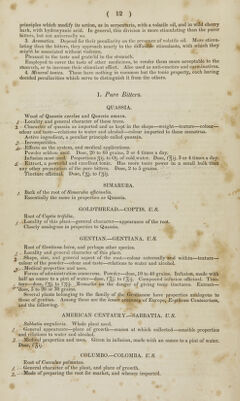
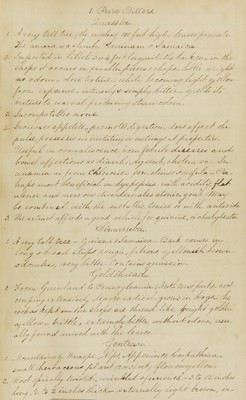
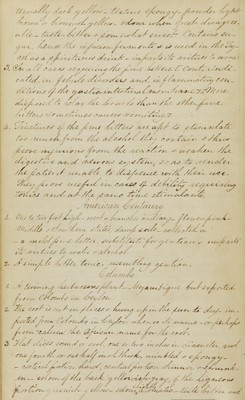
![( 12 ) principles which modify its action, as in serpentaria, with a volatile oil, and in wild cherry bark, with hydrocyanic acid. In general, this division is more stimulating than the purer bitters, but not universally so. 3. Aromatics. Depend for their peculiarity on tlie presence of volatile oil. More stimu- lating than the bitters, they approach nearly to the diffusible stimulants, with which they might be associated without violence. Pleasant to the taste and gratel'ul to the stomach. Employed to cover the taste of other medicines, to render them more acceptable to the stormch, or to increase their stimulant effect. Also used as anti-emetics and carminatives. 4. Mineral tonics. These have nothing in common but the tonic property, each having decided peculiarities which serve to distinguish it from the others. 1. Pure Bitters. QUASSIA. Wood of Quassia excelsa and Quassia amara. / • -Locality and general character of these trees. X- -Character of quassia as imported and as kept in the shops—weight—texture—colour— odour and taste—relations to water and alcohol—colour imparted to these menstrua. Active ingredient, a peculiar principle called quassin. 2. ■ Incompatibles. Jjj- -Effects on the system, and medical applications. Powder seldom used. Dose, 20 to 60 grains, 3 or 4 times a day. Infusion most used. Proportions gij. to Oj. of cold water. Dose, f]fij. 3 or 4 times a day. £■■ Extract, a powerful and excellent tonic. Has more tonic power in a small bulk than any other preparation of the pure bitters. Dose, 2 to 5 grains. Tineture officinal. Dose, f^j. to f^ij. SIMARUBA. / Bark of the root of Simaruha officinalis. Essentially the same in properties as Quassia. GOLDTHREAD.—COPTIS. U.S. Root of Coptis trifolia. /..Locality of this plant—general character—appearance of the root. Closely analogous in properties to Quassia. GENTIAN.—GENTIANA. U.S. Root of Gentiana lulea, and perhaps other species. / ..Locality and general character of this plant. j.. .Shape, size, and general aspect of the root—colour externally and within—texture- colour of the powder—odour and taste—relations to water and alcohol. *.. .Medical properties and uses. Forms of administration numerous. Powder—dose, 10 to 40 grains. Infusion, made with half an ounce to a pint of water—dose, fijj. to f.^ij. Compound infusion officinal. Tinc- ture—^ose, fjJj-JoJ^ij.^Remarks on the danger of giving tonic tinctures. Extract— lose, 5 fcTSO or 30 grains. Several plants belonging to the family of the Gentianeae have properties analogous to those of gentian. Among these are the lesser centaury of Europe, Erythrcea Cenlaurium, and the following. . ture ^close AMERICAN CENTAURY.—SABBATIA. U.S. Sabbatia angularis. Whole plant used. / . - General appearance—place of growth—season at which collected—sensible properties and relations to water and alcohol. 2. • ■ Medical properties and uses. Given in infusion, made with an ounce to a pint of water. Dose, fgij. COLUMBO.—COLOMBA. U.S. Root of Cocculus palmatus. / . .General character of the plant, and place of growth.](https://iiif.wellcomecollection.org/image/b21165178_0040.jp2/full/800%2C/0/default.jpg)