[Report 1947] / Medical Officer of Health, Clackmannan County Council.
- Clackmannanshire (Scotland). County Council.
- Date:
- 1947
Licence: Attribution 4.0 International (CC BY 4.0)
Credit: [Report 1947] / Medical Officer of Health, Clackmannan County Council. Source: Wellcome Collection.
65/86 page 27
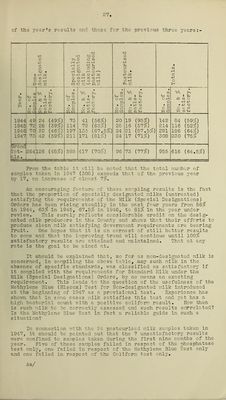
![27 of the year’s results and those for the previous three years:- Year. i Non- designated milk. I i Specially designated milk (excluding pasteurised milk) Pasteurised milk. 1 1 1 jTotals. 1 CO 0 C 1— 0 • -a O 0 & m tfo. & % satis- factory. No. of Samples . , ' ^ oS CO O •H -P • -P o Odd IS CQ <H No. of Samples. No. & % satis- factory. No. of Samples. No. & % satis- factory. i J 1944 49 24 (49%) 73 41 (56%) 20 19 (95%) 142 84 (59%) 1945 72 28 (39%) 114 72 (63%) 28 16 (57%) 214 116 (52%) 1946 70 32 (46%) 197 133 (67.5%) 24 21 (87.5%) 291 186 (64%) 1947 73 42 (59%) 211 171 (81%) 24 17 (71%) 308 230 (75% Grand] Tot- 264126 (48%) 595 417 (70%) 96 73 (77%) 955 616 (64.5%) als . — From the table it will be noted that the total number of samples taken in 1947 (308) exceeds that of the previous year by 17, an increase of almost 7%. An encouraging feature of these sampling results is the fact that the proportion of specially designated milks (untreated) satisfying the requirements of the Milk (Special Designations) Orders has been rising steadily in the past four years from 56% in 1944, 63% in 1945, 67.5% in 1946, to 81% in the year under review. This surely reflects considerable credit on the desig- nated milk producers in the County and shows that their efforts to produce clean milk satisfying Government requirements are bearing fruit. One hopes that it is an earnest of still better results to come and that the improving trend will continue until 100% satisfactory results are attained and maintained. That at any rate is the goal to be aimed at. It should be explained that, so far as non-designated milk is concerned, in compiling the above table, -any such milk In the absence of specific standards, was classified as satisfactory if it complied with the requirements for Standard Milk under the Milk (Special Designations) Orders, by no means an exacting requirement. This leads to the question of the usefulness of the Methylene Blue (Hiscox) Test for Non-designated milk introduced at the beginning of 1947 as a provisional test. Experience has shown that in seme cases milk satisfies this test and yet has a high bacterial count with a positive coliform result. How then is such milk to be correctly assessed and such results correlated? Is the Methylene Blue Test in fact a reliable guide in such a situation? In connection with the 24 pasteurised milk samples taken in 1947, it should be pointed out that the 7 unsatisfactory results were confined to samples taken during the first nine months of the year. Five of these samples failed in respect of the' phosphatase test only, one failed in respect of the Methylene Blue Test only and one failed in respect of the Coliform test only. As/](https://iiif.wellcomecollection.org/image/b28648213_0065.jp2/full/800%2C/0/default.jpg)