A manual of practical hygiene / by Edmund A. Parkes ; edited by F.S.B. Francois de Chaumont.
- Date:
- 1887
Licence: Public Domain Mark
Credit: A manual of practical hygiene / by Edmund A. Parkes ; edited by F.S.B. Francois de Chaumont. Source: Wellcome Collection.
Provider: This material has been provided by the Royal College of Physicians of Edinburgh. The original may be consulted at the Royal College of Physicians of Edinburgh.
50/838 page 26
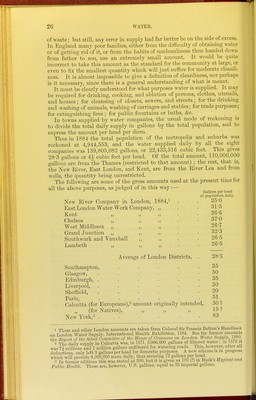
![of waste; but still, any error in supply had far better be on the side of excess. In England many poor families, either from the difficulty of obtaining water or of getting rid of it, or from the habits of uncleanliness thus handed down from father to son, use an extremely small amount. It would be quite incorrect to take this amount as the standard for the community at large, or even to fix the smallest quantity which will just suffice for moderate cleanli- ness. It is almost impossible to give a definition of cleanliness, nor perhaps is it necessary, since there is a general understanding of what is meant. It must be clearly understood for what purposes water is supplied. It may be required for drinking, cooking, and ablution of persons, clothes, utensils, and houses; for cleansing of closets, sewers, and streets; for the di-inking and washing of animals, washing of carriages and stables; for trade purposes; for extinguishing fires; for public fountains or baths, (fee. In towns supphed by water companies, the usual mode of reckoning is to divide the total daily supply in gallons by the total population, and to express the amount per head per diem. Thus in 1884 the total population of the metropolis and suburbs was reckoned at 4,944,553, and the water supphed daily by all the eight companies was 139,805,082 gallons, or 22,433,516 cubic feet. This gives 28-3 gallons or 4| cubic feet per head. Of the total amount, 110,000,000 gallons are from the Thames (restricted to that amount); the rest, that is, the New Eiver, East London, and Kent, are from the River Lea and from wells, the quantity being unrestricted. The following are some of the gross amounts used at the present time for all the above purposes, as judged of in this way :— New River Company in London, 1884,^ East London Water-Work Company, „ Kent „ „ „ Chelsea „ ,, West Middlesex „ „ „ Grand Junction ,, ,, ,, Southwark and Vauxhall ,, ,, Lambeth „ ,, „ Average of London Districts, Southampton, Glasgow, Edinbvirgh, . Liverpool, Sheffield, Paris, Calcutta (for Europeans),^ amount originally intended, „ (for Natives), „ ,, „ New York,^ ...... Gallons per head of population daily. 25- 0 31- 5 26- 6 37-0 26-7 32- 3 26-5 26-5 28-3 35 50 35 30 20 31 30? 15? 83 1 These and other London amounts are taken from Colonel Sir Francis Bolton's Handbook on London Water Supply, International Health Exhibition, 1884. See for former amounts the Report of the Select Covimittee of the Homeof Comnw^^^^^ London TFa<«- S»i>^/^(/, 1880. 2 The daily supply in Calcutta was, in 1871, .-..OOCOOO gallons of filtered water ; m lS/9 t was 7+ millions and 1 million gallons unfiltered for watering roads. This, however, after all deductions, only left 3 gallons per head for domestic purposes A new scheme is in progress which will provide 8,000,000 more daily, thus securing 12 gallons per head. . 3 In former editions this was stated at 300, but it is given as 100 (?) in V.x,c]^'s Hygiene and Public Health. These are, however, U.S. gallons, equal to 83 imperial gallons.](https://iiif.wellcomecollection.org/image/b21932980_0050.jp2/full/800%2C/0/default.jpg)




 No text description is available for this image
 No text description is available for this image
 No text description is available for this image