A manual of practical hygiene / by Edmund A. Parkes ; edited by F.S.B. Francois de Chaumont.
- Date:
- 1887
Licence: Public Domain Mark
Credit: A manual of practical hygiene / by Edmund A. Parkes ; edited by F.S.B. Francois de Chaumont. Source: Wellcome Collection.
Provider: This material has been provided by the Royal College of Physicians of Edinburgh. The original may be consulted at the Royal College of Physicians of Edinburgh.
741/838 (page 689)
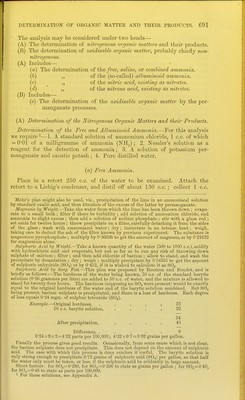
![iiiainder (= 100 of unboiled water) and determine hardness.^ After deduct- ing 2 measures, divide the number of measures by 2 for the hardness of 50 c.c, and calculate as usual. By boiling, all carbonic acid is driven off; all calcium carbonate, except a small quantity, is thrown down ] the calcium sulphate and chloride are not affected if the evaporation is not carried too far; the magnesium carbonate at first thrown down is redissolved as the water cools. Example.—Before boiling, 32.measures, and after boiling, 13 measures, of the soap solution were used. 13-2( = ll)-f-2 = 5-5 degrees of the metrical scale. 5-5 X 0'7 = 3 85 degrees of Clark's scale. (c) Removable Hardness.—The difference between the total and the per- manent hardness is the temporary or removable hardness, which in the example would be 15 - 5'5 = 9'5 degrees of the metrical scale, and 10-5 - 3'85 = 6*65 degrees of Clark's scale. The amount of permanent hardness is very important, as it chiefly repre- sents the most objectionable earthy salts—viz., calcium sulphate and chloride, and the magnesian salts. The greater the permanent hardness, the more objectionable is the water. The permanent hardness of a good water should not, if possible, be greater than about 5° of the metrical scale, equal to 3° or 4° of Clark's scale. The determination, then, of 1. The total hardness, 2. The pei'manent ox fixed hardness, 3. The temporary or removable hardness, will enable us to speak positively as to the hygienic characters of a water, so far as earthy salts are concerned.^ 1 If there is mucli fixed hardness this process is hardly available. 2 Determination of certain Constituents hy Soap.—In many cases the analysis must end with the above processes ; but it may be desirable to carry it further, and to determine the amount of some ingredients ; for example, lime, magnesia, sulphuric acid, carbonic acid. An approximate estimate can be given of several of these ingredients by the soap test, which is sufficient for hygienic purposes ; and any one who has learned to determine properly the hardness of a water will be able to carry on the yjrocess into finer details. Lime by the Soap Test.-—Messrs Boutron and Boudet have proposed, after determination of total hardness, to precipitate the lime by ammonium oxalate, and then to determine the hard- ness again. The difference will be owing to lime removed. The difficulty here is to add enough, and not too much, of ammonium oxalate, which itself in excess gives hardness. The best way to perform this process is to have a perfectly concentrated clear solution of ammonium oxalate, and to add to 50 c.c. of water 1 drop for every 4 measures of soap solution used ; then in other bottles, to add respectively 1, 2, and 3 drops more. Then determine hardness of all the bottles and select the result which gives the least hardness. In this way we can hit on the bottle which contains enough, but not too much ammonium oxalate. The water need not be filtered, but it should be allowed to stand at least for three or four hours, or, better still, twenty-four hours, before the hardness is taken. Then multiply the difference between the total hardness and the hardness after the addition of the oxalate by the coefficient for lime; thisis0'14of a milligramme, as each measure of the soap solution is equivalent to this amount of lime. Example.—Total hardness, .... 32 After lime precipitated, .... 10 Difference, .... 22 22 measures x 0-14 x 2=6-16 parts of lime per 100,000 and 616 x 0-7=:4-312 grains per gallon. Or multiply the number of measures by 0-28, this gives parts per 100,000 ; or by 0196, the result is grains per gallon. If carefully done, this result will be near the truth. Magnesia by the Soap Test.—Boutron and Boudet propose to determine the magnesia by boiling the water from which the lime has been thrown down. All usual elements of hard- ness, except the magnesia, are thus got rid of. This is by no means so accurate a process as that of the lime ; the lather is formed much less perfectly and sliai-ply, and in addition the 2x](https://iiif.wellcomecollection.org/image/b21932980_0741.jp2/full/800%2C/0/default.jpg)