[Report 1953] / Medical Officer of Health, Canterbury Borough / City & County.
- Canterbury (England). City & County Council.
- Date:
- 1953
Licence: Attribution 4.0 International (CC BY 4.0)
Credit: [Report 1953] / Medical Officer of Health, Canterbury Borough / City & County. Source: Wellcome Collection.
31/58 page 27
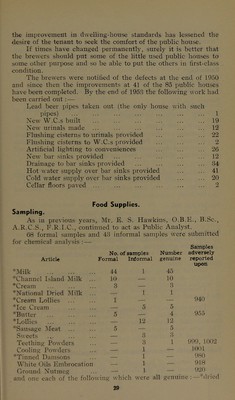
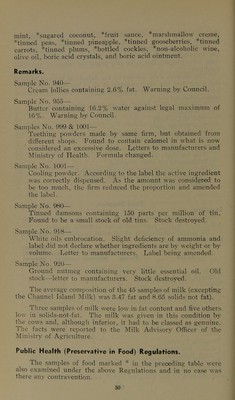
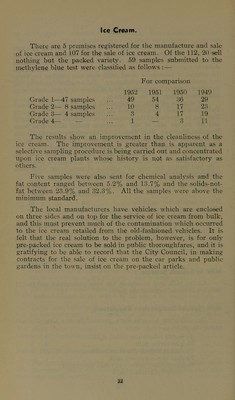
![The meat and other food found to be unsound on inspection in food shops amounted to 17,551 lbs. :■ Meat Canned meat Canned fish Fish Other canned food, etc. vere found to be unfit for human food. 3,303^ lbs. 1,755 lbs. mu lbs. 336 lbs. 12,0895< lbs. The unsound food with the exception of the meat was des- troyed locally, but the meat, as the pro]>ert3^ of the Ministry of Food, was sold by them. The instructions regarding the dyeing of carcases green were carried out, but it is extremely difl&cult to colour satisfactorily bovine carcases. It is felt that the only proper method of disposal of diseased meat is for it to be taken direct from the Abattoir to a factorj'^ with a steam sterilising plant specially designed for the purpose. The present method of dis- posal to a firm over 100 miles away and collection by someone else in another part of the country leaves too much opportunity for meat to go astray. It is perhai^s not out of place to comment on the working of the Abattoir which it is readily admitted is almost beyond the realms of expectation of a quarter of a century’ ago when I became interested in slaughter houses. There are good facilities for the resting of animals prior to slaughter and an abundant supply of drinking water is provided. The treatment of the animals is in a most humane manner and all are slaughtered with up-to-date appliances, one at a time, and not in sight of the slaughtering processes. Every possible endeavour is made to produce clean meat and the daily practice of putting all carcases in the chilled rooms until they leave the Abattoir greater improves the appear- ance of meat, and what is more important, eliminates the possi- bilities of blow-fly contamination. Further, the concentration of slaughtering has enabled various by-products usvrally wasted in small-scale slaughtering, to be put to good account. The blood is collected for edible purposes or for artificial manure, and various glands such as pineal, pituitary, thyroid, supra renal, ovaries, and prostate, as well as certain unsound livers, are collected for manufacture into pharmaceutical products. Unfavourable criticism has been made of the meat transport in previous years, and no improvements apart from providing the floors of the vans with a metal covering were carried out in 1953. The vans are provided with hanging rails so that the carcases of mutton, pork, veal and hind quarters of all except verv large beasts, may be hung clear of the floor. The forequarters of beasts are usually not hung and the danger of contamination from the boots of the personnel also applies to the carcases which arc hung, which are dragged about the floor of the van during loading and unloading. To overcome this possible contamination and the danger of injury to the employees handling heavv carcases, it is](https://iiif.wellcomecollection.org/image/b29091512_0033.jp2/full/800%2C/0/default.jpg)



 No text description is available for this image
 No text description is available for this image
 No text description is available for this image