Volume 1
Principles and practice of medical genetics / editors, Alan E.H. Emery, David L. Rimoin ; assistant editor, Jeffrey A. Sofaer ; editorial assistant, A.P. Garber ; foreword by Victor A. McKusick.
- Date:
- 1983
Licence: Attribution-NonCommercial 4.0 International (CC BY-NC 4.0)
Credit: Principles and practice of medical genetics / editors, Alan E.H. Emery, David L. Rimoin ; assistant editor, Jeffrey A. Sofaer ; editorial assistant, A.P. Garber ; foreword by Victor A. McKusick. Source: Wellcome Collection.
101/784 (page 73)
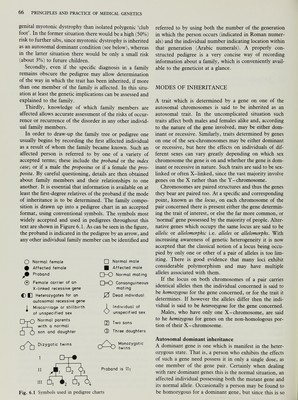
![Possible combinations: Carrier female (xX) Normal male (XY) carrier normal affected normal daughter daughter son son distinction between the two situations is of course vital if such a woman seeks genetic advice since one results from heterozygosity for an X-linked gene and the other from the homozygous state of an autosomal recessive gene. There are several reasons which may account for a woman exhibiting an X-linked recessive trait: (a) She may have an abnormal sex chromosome con stitution such as XO (Turner syndrome) or XY (testi cular féminisation syndrome). In fact there are several girls reported in the literature who seemed to have classic Duchenne muscular dystrophy and who proved to have only one X-chromosome. (b) She may be homozygous for the mutant gene either because her mother was a carrier and her father affected, or because one parent bore the mutant gene and a mutation occurred in the gamete from the other parent. Such a female will usually be affected as severely as a hemizygous male with the disorder and all her sons will be affected. (c) Lastly, she may be a ‘manifesting heterozygote’. She is heterozygous for the mutant gene, but perhaps because of ‘Lyonisation’ it is possible that by chance most of the active X-chromosomes are those bearing the mutant gene. Although this is the usual explanation given for such a situation, it is doubtful if Lyonisation alone accounts for it since familial aggregation of mani festing carriers has been shown, for example, in the series of manifesting carriers of Duchenne muscular dystrophy reported by Moser and Emery ( 1974). If Lyonisation were the only cause then one might expect a random distri bution of such manifesting heterozygotes amongst the population of carriers, although there is some experi mental evidence to indicate that X-chromosome inacti vation can be genetically controlled. When giving genetic advice to members of a family with an X-linked recessive disorder, such advice is nat urally made more accurate if there is the possibility of distinguishing between those females who are heterozy gous carriers and those who are not. In a number of X-linked recessive disorders carrier detection tests are now available and examples of these are given in Table 6.5. The subject is dealt with in greater detail elsewhere. X-linked dominant inheritance An X-linked dominant trait is one which is manifest both in the hemizygous male and in the heterozygous female. The gene is transmitted by affected females to half of their daughters and by affected males to all of their daughters. The trait is also transmitted by affected Table 6.5 Some examples of X-linked recessive disorders in which carrier detection is possible Disorder Abnormality in carriers Ocular albinism Duchenne muscular dystrophy | Patchy depigmentation of retina and iris and } Becker muscular dystrophy ] Elevated serum creatine kinase level Haemophilia A Abnormal ratio of factor VIII to inactive antigen. Haemophilia B Decreased factor IX level Fabry disease Decreased a-galactoside in skin fibroblasts. 2 populations of cells demonstrable Oculo-cerebro-renal syndrome ? lenticular opacities Lesch-Nyhan syndrome Decreased hypoxanthine-guanine phosphoribosyl transferase activity. 2 populations of cells demonstrable](https://iiif.wellcomecollection.org/image/b18037446_vol_1_0102.JP2/full/800%2C/0/default.jpg)