[Report 1954] / School Medical Officer of Health, Glamorgan County Council.
- Glamorgan (Wales). County Council. nb2014013905.
- Date:
- 1954
Licence: Attribution 4.0 International (CC BY 4.0)
Credit: [Report 1954] / School Medical Officer of Health, Glamorgan County Council. Source: Wellcome Collection.
36/62 page 34
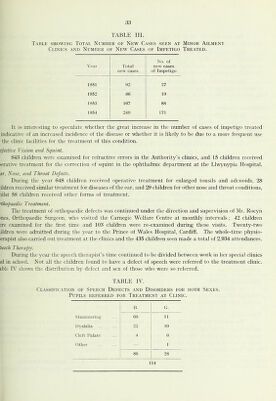
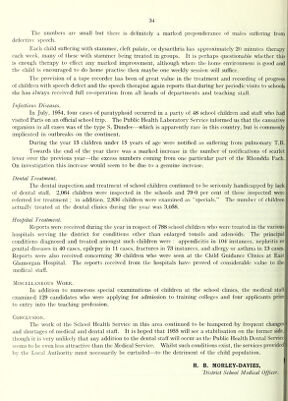
![The numbers are small but there is dehnitely a marked preponderance of males suffering from , defective speech. Each child suffering with stammer, cleft palate, or dysarthria has approximately 20 minutes therapy each week, man}' of these with stammer being treated in groups. It is perhaps questionable whether this is enough therapy to effect any marked improvement, although where the home environment is good and the child is encouraged to do home practise then maybe one weekly session will suffice. | The provision of a tape recorder has been of great value in the treatment and recording of progress of children with speech defect and the speech therapist again reports that during her periodic visits to schools she has always received full co-operation from all heads of departments and teaching staff. Infectious Diseases. In July, 1954, four cases of paratyphoid occurred in a party of 48 school cliildren and staff who had visited Paris on an official school trip. The Public Health Laboratory Service informed us that the causative organism in all cases was of the type S. Dundee—-which is apparently rare in this country, but is commonly implicated in outbreaks on the continent. During the year 15 children under 15 years of age were notified as suffering from pulmonary T.B. Towards the end of the year there was a marked increase in the number of notifications of scarlet fever over the previous year—the excess numbers coming from one particular part of the Rhondda Each. I On investigation this increase would seem to be due to a genuine increase. Dental Treatment. \ The dental inspection and treatment of school children continued to be seriously handicapped by lack of dental staff. 2,064 children were inspected in the schools and 79-0 per cent of those inspected were referred for treatment ; in addition, 2,836 children were examined as specials.” The number of children actually treated at the dental clinics during the year was 3,058. ! Hospital Treatment. Reports were received during the year in respect of 788 school children who were treated in the various hospitals serving the district for conditions other than enlarged tonsils and adenoids. The principal conditions diagnosed and treated amongst such children were : appendicitis in 104 instances, nephritis or genital diseases in 40 cases, epilepsy in 11 cases, fractures in 73 instances, and allergy or asthma in 13 cases. Reports were also received concerning 30 children who were seen at the Child Guidance Clinics at East Glamorgan Hospital. The reports received from the hospitals have proved of considerable value to the medical staff. Miscellaneous Work. In addition to numerous special examinations of children at the school clinics, the medical staff examined 129 candidates who were applying for admission to training colleges and four applicants prior to entry into the teaching profession. Conclusion. The work of the School Health Service in this area continued to be hampered by frequent changes and .shortages of medical and dental staff. It is hoped that 1955 will see a stabilisation on the former side, though it is very unlikely that any addition to the dental staff will occur as the Public Health Dental Service seems to be even less attractive than the Medical Service. Whilst such conditions exist, the services provided by tlie Lf)ca] Authority must necessarily be curtailed—to the detriment of the child population. R. B. MORLEY-DAVIES, 'District School Medical Officer.](https://iiif.wellcomecollection.org/image/b28844853_0038.jp2/full/800%2C/0/default.jpg)