Micrographia: or some physiological descriptions of minute bodies made by magnifying glasses. With observations and inquiries thereupon / By R. Hooke.
- Robert Hooke
- Date:
- 1665
Licence: Public Domain Mark
Credit: Micrographia: or some physiological descriptions of minute bodies made by magnifying glasses. With observations and inquiries thereupon / By R. Hooke. Source: Wellcome Collection.
263/384 page 201
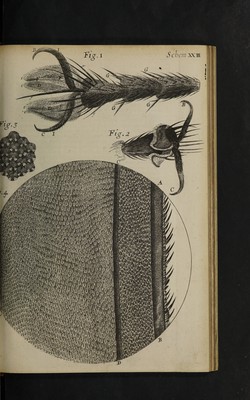
![ruggednefiof <hefurfacc: and chiefly frornaikind oftarnifil, ©r dirty fmoaky fubftanee, which adheres to the furface of that very hard body,3 and though the pointed parts cannot penetrate the fubftanee ©fjcjlafoycr may they find pores enough in the tarnifh, or at leaftmake them. This Stru&ure I fomevvhat the more diligently furveyjd, becaufe I could not well comprehend, how, if there were fuch a glutinous matter in thofe fuppoled Sponges, as moil:-(that have ©bferv’dtirat'Obl]e(2: in a Microjcope) have hitherto believ’d,how, T fay, the fly could lb readily ut> glew and loofen its feet: and, becaule I have not found arrf bWifcmcrea- ture to have a contrivance any ways like it 5 and chiefly, that we might not be call upon unintelligible explications of the Thcno-menn of Nature, at lead others then the true ones, where our fenfes were able to fhrrrrfh us with an intelligible, rationall and true one. Somewhat a like contrivance to this of Flies (hall we find in moft other Animals, fuch as all kinds of Flies and cafe-wing’d creatures, bay, in a Flea, an Animal abundantly fmaller then this Fly. Other creatures, as Mites, the Land-Crab, &c. have onely one fmall very fharp Tallon at the end of each of their legs, which all drawing towards the center or middle of their body, inable thefe exceeding light bodies to fufpendand fatten themfelves to almoft any furface. s / Which how they are able to do, will not feem ttrange, if we coofider, firft, how little body there is in one of thefe creatures compar’d to their luperficies, or outfide,their thicknefs, perhaps, oftentimes,not amounting to the hundredth part of an Inch: Next, the ftrength and agility of tfoefe creatures compar’d to their bulk, being, proportionable to their bulk, perhaps, an hundred times ftronger then an Horfe or Man. And third ly^ if we confider that Nature does always appropriate the inftruments, fb as they are the moft fit and convenient to perform their offices, and the moft Ample and plain that poflibly can be, this we may fee further verb fy’d alfointhefbotof aLoufewhich is very much differing from thofe I have been deferibing, but more convenient and neceflary for the place of its habitation, each of his leggs being footed with a couple of fmall claws which he can open or fhut at pleafure, ftiap’d almoft like the claws- of a Lobfter or Crab,but with appropriated contrivances for his peculiar life, which being to move its body to and fro upon the hairs of the crea¬ ture it inhabits. Nature has furnilh’d one of its claws with joints, almoft like the joints of a man s fingers, lb as thereby it is able to encompafsor gralp a hair as firmly as a man can a ftick or rope. Nor, is there a lcls admirable and wonderfull Muhanifm in the foot of a Spider, whereby he is able to fpin, weave, and climb, or run on his curious -tranfparent clew, of which I fhall fay more in the defeription of that Animal. And to conclude, we fhall in all things find, that Nature does not onely work Mechanically, but by fuch excellent and moft compendi¬ ous, as well as ftupendious contrivances, that it were impofiible for all the reafon in the world to find out any contrivance to do the fame thing that fhould have more convenient properties. And can any be fo fottifh, A a 2 as](https://iiif.wellcomecollection.org/image/b30326370_0263.jp2/full/800%2C/0/default.jpg)