Micrographia: or some physiological descriptions of minute bodies made by magnifying glasses. With observations and inquiries thereupon / By R. Hooke.
- Robert Hooke
- Date:
- 1665
Licence: Public Domain Mark
Credit: Micrographia: or some physiological descriptions of minute bodies made by magnifying glasses. With observations and inquiries thereupon / By R. Hooke. Source: Wellcome Collection.
266/384 page 204
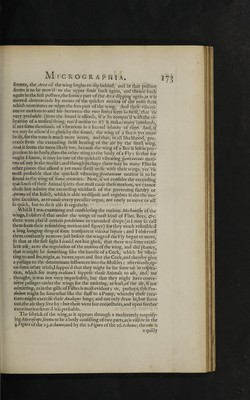
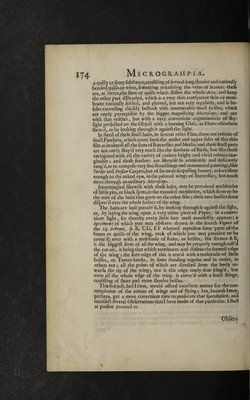
![174 a quilly or finny fubftance,confifting of feveral long,llender and varioufly bended quills or wires, fomething refembling the veins of leaves} theie are, as ’twere,the firms or quills which ftiffen the whole Area, and keep the other part diftended, which is a very thin tranfparent lkin or mem¬ brane variously folded, and platted, but not very regularly, and is be¬ sides exceeding thickly beftuck with innumerable fmall brides, which are onely perceptible by the bigger magnifying Microfiope, and not with that neither, but with a very convenient augmentation of (ky- light proje&ed on theObjett with a burning Glafs, as I have elfewhere (hew d, or by looking through it againft the light. In deed of theie fmall hairs, in feveral other Flies, there are infinite of fmall Feathers, which cover both the under and upper fides of this thin film a?-i« almoft all the forts of Butterflies and Moths: and thole finall parts are not onely lhapd very much like the feathers of Birds, but likethofe variegated with all the variety of curious bright and vivid colours ima¬ ginable 5 and thofe feathers are likewife fo admirably and delicately rang’d,as to compofe very fine flourilhings and ornamental paintings,like Turfye and Perfian Carpets,but of far more furpafling beauty, as is evident enough to the naked eye, in the painted wings of Butterflies, but much more through an ordinary Microfiope. Intermingled likewife with thefe hairs, may be perceived multitudes of little pits, or black lpots,in the exended membrane, which feemto be the root of the hairs that grow on the other fide, thefe two bodies feem dilpers’d over the whole furface of the wing. The hairs are bell: perceiv’d, by looking through it againft the light, or, by laying the wing upon a very white piece of Paper, in a conve¬ nient light, for thereby every little hair moft manifeftly appears , a Specimen r of which you may obferve drawn in the fourth Figure of the 23. Scheme, A B, CD, EF whereof reprefent fome parts of the bones or quills of the wing, each of which you may perceive to be cover’d] over with a multitude of fcales, or brilles, the former A B, is the biggeft ftem of all the wing, and may be properly enough call’d the cut-air, it being that which terminates and ftiffens the formoft edge of the wing 5 the fore-edge of this is arm’d with a multitude of little brilles, or Tenter-hooks, in fome ftanding regular and in order, in others not 5 all the points of which are direfted from the body to¬ wards the tip of the wing*, nor is this edge onely thus fring’d, but even all the whole edge of the wing is cover’d with a fmall fringe, confifting of Ihort and more (lender brilles. This Subjeift, had I time, would afford excellent matter for the con¬ templation of the nature of wings and of flying } but, becaufe I may, perhaps, get a more convenient time to profecute that fpeculation, and recolleft icveral Obfervations that I have made of that particular. I (hall at prefent proceed to • * ‘. r • • *. \j u i Obfcrv* * t.](https://iiif.wellcomecollection.org/image/b30326370_0266.jp2/full/800%2C/0/default.jpg)